“We’re all going to be very stupid.” That sentence was the opening line of a LinkedIn post I came across recently. It came from a casual conversation the author had with his next-door neighbor, a second-year law student at the University of Technology Sydney. They started talking about what’s happening at university now that generative AI is everywhere. And — surprise-surprise! — according to the student, everyone cheats. And a lot are using AI to cheat at exams, and universities have effectively lost control.
The topic starter argued that exam halls would still solve the problem. After all, it’s much harder to cheat with AI when you’re sitting in a supervised room. But the student’s response was simple: the university no longer runs in-person exams. They’re too expensive.
And the conclusion of the post followed almost inevitably: universities know students are cheating with AI, they know learning is compromised, and yet they are not bringing back the obvious solution (=in-person supervised exams). Together this leads to the dramatic takeaway: if this is where higher education has arrived, we’re all doomed.
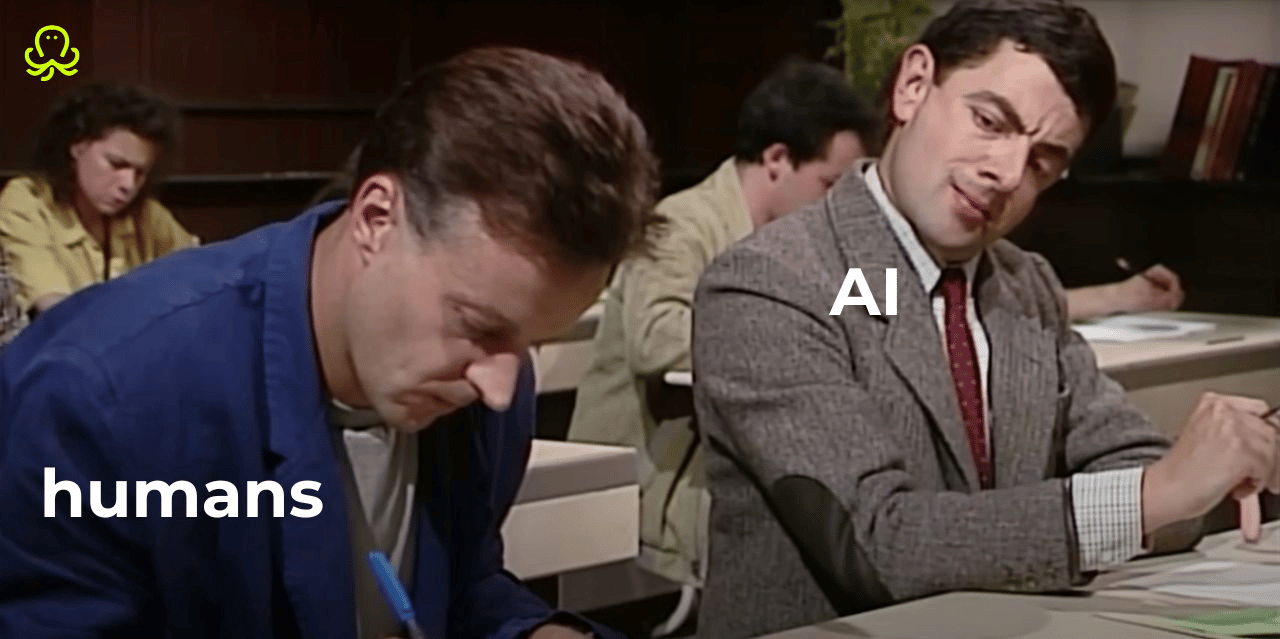
When I read that story, I had a strange sense of déjà vu. Because I’ve heard exactly the same argument before (and am still hearing it now) in the workspace. After the large global shift to remote, a familiar narrative emerged: productivity is dropping, people are slacking, and collaboration is dying. And the proposed solution was beautifully simple — bring everyone back to the office. Problem solved. And now I’m hearing something that sounds remarkably similar in discussions about AI in higher education.
I also feel another force quietly operating in these conversations: nostalgia. The idea that things used to work better. The grass was greener, the sky was bluer, and everyone was more productive when we were all sitting in offices under fluorescent lights and eating sad desk lunches. In the same spirit, exams somehow felt more honest when everyone was sitting in a large hall with identical papers and pens. But nostalgia has a funny way of simplifying the past.
Systems that seemed stable often only looked that way because their weaknesses were harder to see. Technology didn’t suddenly create new problems; in many cases, it simply made old ones impossible to ignore. Which brings us to a pattern I keep noticing. Whenever a system starts to wobble, the instinctive response is often the same: go back to how things used to be.
There’s something psychologically comforting about simple fixes. Erase and rewind. Back to the office. Back to exam halls. The logic feels almost irresistible: if something stopped working after a change, undo the change and everything should go back to normal. Except systems rarely work that way.
Take remote work. When large parts of the workforce moved out of offices, management became incredibly concerned about possible productivity and collaboration drops. The first layer of attempted fixes came quickly: activity tracking software. Screenshots, keystroke monitoring, presence indicators, endless dashboards trying to prove that work was happening. Did that fix underperformance? Not really — people found workarounds. They always do. Mechanical control rarely fixes structural problems.
The next seemingly obvious solution was to send everyone back to the office. But offices didn’t magically restore productivity, because remote work itself wasn’t the root problem. Management practices, unclear goals, poor incentives, and weak processes were.
And I can’t help but wonder whether we’re seeing the same reflex now in discussions about AI cheating in higher education, with the one simple answer — bring exams back on campus and everything will be fine again.
But if the real issue lies deeper, in how we design assessments, what we actually measure, and how education adapts to AI in higher education, then exam halls may not magically restore integrity either. Just like office desks didn’t magically restore productivity. And if that’s the case, we may be focusing on the wrong lever entirely.
Whenever discussions about AI cheating appear, the tone often suggests that something entirely new — and entirely catastrophic — has suddenly arrived in education. But cheating itself is not new — students have always cheated.
Long before generative AI entered the picture, there were cheat sheets hidden in sleeves, whispered answers during exams, shared papers, hired essay writers, and late-night group chats where tomorrow’s test somehow “mysteriously” appeared.
The tools evolve, but the behavior itself is ancient. In fact, if you look closely, the relationship between technology and cheating starts to resemble a familiar pattern: an arms race. One side develops new monitoring tools, the other side develops new ways around them. Institutions introduce stricter controls, students find smarter shortcuts.

And today, the new variable in that race is using AI in higher education. Now we hear phrases like students using AI to cheat, students cheating with AI, or even the dramatic claim that everyone is cheating their way through college. And yes, some students absolutely do cheat with AI. Some ask models to generate essays, solve problem sets, or suggest answers during exams.
But the presence of AI and cheating doesn’t automatically mean the system has suddenly collapsed. It means the tools available in the arms race have changed, which brings us to a more interesting question. The real issue was never whether cheating exists (it always has), the real question is whether the way we design assessments has evolved along with the tools people now use to learn and work.
Because if assessment design hasn’t changed, then the problem may not be that students are using AI to cheat. The problem may be that the system they’re interacting with was designed for a world that no longer exists.
Let’s get back to the LinkedIn discussion, there was one response that — again — stayed with me. The argument was simple: people working from home still produce real output. Students using AI during exams do not. I understand the intuition behind that argument, but reality is rarely that binary.
Because just as not all work-from-home equals deep, meaningful work, not all AI use equals zero cognition. Anyone who has spent time interacting with modern AI systems quickly discovers something interesting: getting useful output requires thinking. At least, you need to frame the question and structure the task. You often need to refine the request a couple of times.
Prompting, in many ways, is simply task-setting language. It’s the process of translating a vague idea into a structured instruction. And structuring a request is cognitive work.
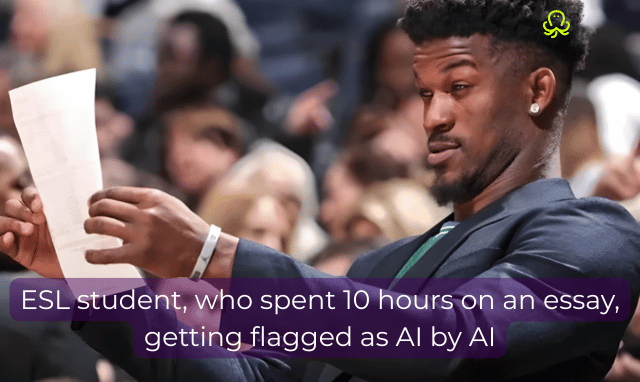
Which raises a slightly uncomfortable question for education: When we evaluate academic output, what exactly are we measuring? Thinking? Or formatting compliance? Because those two things are obviously not the same.
I learned that distinction the hard way when I was finishing my master’s degree 25 years ago (yes, I’m that old;-))). The research itself was fascinating. I loved the thinking, the synthesis, the writing. Exploring the topic felt energizing, almost addictive. The intellectual part of the process was exactly what you imagine when you think about academic work. What actually destroyed my academic ambition was formatting. Margins had to be exactly right. Headings needed to follow precise rules. Footnotes were apparently a sacred science. I reprinted my thesis about ten times, trying to match the university’s formatting requirements. Ten.
After the last attempt, I remember staring at the stack of rejected printouts and realizing something uncomfortable: the most exhausting part of the entire process had absolutely nothing to do with thinking. Somewhere around that moment, my dream of doing a PhD evaporated completely. And sometimes I joke that if my 45-year-old self could send ChatGPT back in time to my 20-year-old self just to handle formatting, I might be a Doctor by now.
Which leads me to a rhetorical question I keep coming back to when people discuss AI and cheating. Which parts of academic output actually matter? The thinking? Or the rituals around presenting it? Because manual suffering has never been a reliable indicator of intellectual rigor.
And if we start confusing ritual with reasoning, we may end up defending the wrong things in the debate about AI cheating in higher education.
There’s another dimension that often gets lost in debates about exam and work formats: the environment in which people are expected to perform. I’ve worked in all possible setups over the years — office-only, fully remote, hybrid. And I’ve noticed something very simple — different environments work differently for different nervous systems.

As someone who is autistic, I know that I’m objectively more productive when working from home. Fewer sensory variables. More control over the environment. Less noise, fewer interruptions, fewer unexpected social signals to process. That combination makes deep focus significantly easier.
But I also know plenty of people who thrive in offices. They draw energy from being around others. They benefit from spontaneous conversations, structured schedules, the momentum of a shared physical space. Both realities exist at the same time. Which is why the remote vs in-person debate often feels oversimplified to me. The real question isn’t which environment is universally better, it’s which environment allows a particular person to produce their best work.
And the same logic applies to exams. For some students, an in-person exam hall can be grounding. The structure is clear, the rules are visible, the atmosphere signals that something serious is happening. For others, the experience can be cognitively draining before the exam even begins. Travel, unfamiliar spaces, background noise, hundreds of people moving around, fluorescent lighting, the strange ritual of sitting shoulder-to-shoulder with strangers while pretending no one else exists. None of this automatically improves thinking.
Which is why I keep coming back to a slightly different question than the one that dominates most discussions about AI in higher education. Instead of asking whether exams should be remote or in-person, or whether students are using AI to cheat, maybe the more useful question is this:
Under what conditions do people produce their most honest and most meaningful work?
Because the real challenge is not choosing between AI or no AI, or remote exams versus exam halls. The real challenge is designing systems that make meaningful output possible in the first place.
When systems start to feel unstable, there’s a very predictable reaction — tighten control. We saw this clearly during the remote work boom. Once companies realized they couldn’t see employees sitting at their desks anymore, many decided to compensate with technology. Suddenly, the market was full of activity trackers, screenshot software, keystroke monitoring, and presence dashboards, all designed to prove that work was happening.
The idea was simple: if we can measure every click, every minute, every movement, productivity will return. But — surprise-surprise! — underperformance didn’t disappear. People simply learned how to game the system. Mouse jigglers appeared. Status indicators stayed permanently green. Screenshots looked busy while actual thinking happened elsewhere or sometimes nowhere at all.
Because when incentives and systems are misaligned, more surveillance doesn’t fix the underlying problem. It just changes how people behave inside the system.
Which is why I can’t help noticing a similar reflex emerging in conversations about students using AI to cheat during exams. As it’s the technology that makes cheating easier, the solution is stronger enforcement: more surveillance, more restrictions, more proctoring.
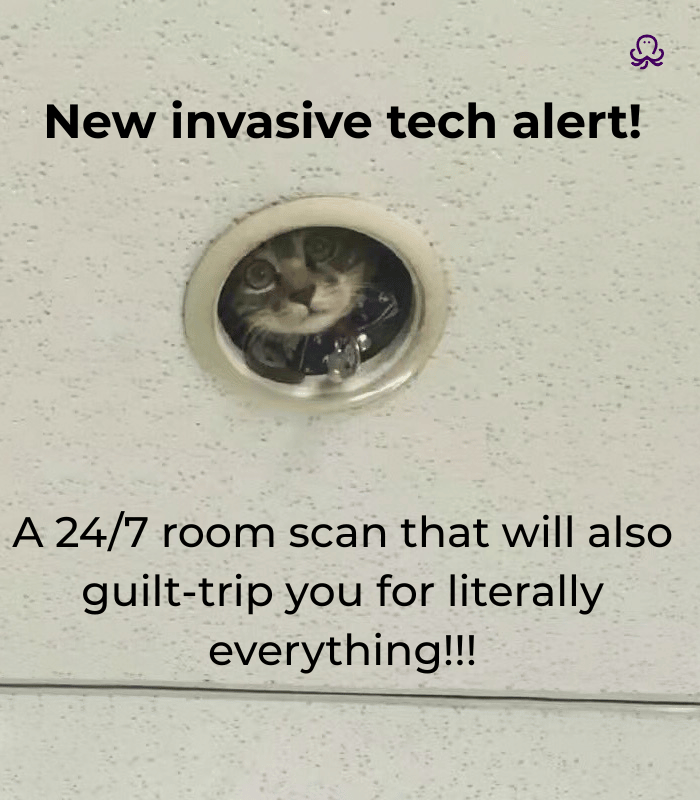
But if the system itself is poorly aligned with how people actually learn and work today, then adding more control may not restore integrity. It may simply produce more sophisticated ways to cheat with AI or bypass monitoring. This is where the real strategic choice appears. Do we double down on surveillance? Or do we step back and ask — again — harder questions. Like what exactly are we measuring? And does that measurement still make sense in a world where AI exists?
At this point, the debate about AI cheating in higher education often sounds like a moral panic. But the more I look at it, the more it seems that we’re not actually facing a cheating crisis. We’re facing a design crisis.
Because the arrival of AI in higher education forces us to confront questions that education systems have quietly avoided for decades:
And perhaps the most uncomfortable question of all: what are we actually evaluating?
If a student uses AI to draft ideas but refines them independently, is that cheating? If someone uses AI to generate a perfect essay but can’t explain the argument afterward, what exactly did the written exam measure? If students are using AI to cheat successfully, does that mean they are dishonest or that the assessment was fragile?
These questions are not easy, but they are necessary. Because the moment powerful tools become part of everyday cognitive work, the boundaries between thinking, collaboration, and assistance become more complex. Trying to solve this complexity by returning to older systems may feel comforting.
Going “back to 1998” often feels safe, but the uncomfortable reality is that we live in 2026. And systems designed for a world without AI may struggle to evaluate people who live and work in one where AI is everywhere.
So the choice we’re facing doesn’t seem to be as simple as it’s often presented. It’s not really office vs home. It’s not exam halls vs remote exams. And it’s certainly not AI vs no AI. Those are surface-level debates, The real choice seems to be something deeper.
One path is to tighten control and hope for obedience. More monitoring. More restrictions. More attempts to prevent students cheating with AI. Even if it means preventing any form of assistance that doesn’t fit neatly into older rules.
The other path is harder but more honest. Redesign systems for the world we actually live in. A world where AI in higher education is already a reality. Where tools will continue to evolve. Where technology and cheating will keep playing their eternal arms race. And where pretending those forces don’t exist won’t make them disappear.
At some point every system faces the same question. Do we try to freeze reality and enforce compliance with rules built for the past? Or do we adapt our systems to evaluate what actually matters now? Because when we strip away the panic around AI cheating, the uncomfortable question underneath it is surprisingly simple:
What do we really want education to optimize for — compliance or capability?
Explore how OctoProctor can support fair, transparent, and scalable assessment without turning exams into surveillance.
Book a demo