Skills lose relevance faster than many organizations anticipate. When companies fail to support ongoing learning, they struggle to keep pace with industry shifts and risk losing skilled talent in the process. At the same time, employees seek opportunities to grow and contribute meaningfully to their work. A strong learning culture addresses both priorities.
Building that culture requires more than offering courses or scheduling training sessions. Leaders must encourage curiosity, create space for knowledge sharing, and recognize progress as employees develop new capabilities. When learning aligns clearly with organizational goals and individual growth, teams integrate development into daily work rather than treating it as an additional task.
To remain competitive and build resilient teams, organizations must recognize how quickly skills, roles, and expectations continue to evolve.
If the phrase “ever-changing world” sounds cliché, it may be because volatility has become routine in many industries. New challenges emerge continuously, technologies advance rapidly, and teams adjust workflows before they fully stabilize.
In some sectors, this happens faster than expected. Marketing illustrates this clearly. When Gucci adopted Instagram’s spatial tagging features, its teams acted quickly, generated 3.7 million interactions in just 48 hours, and increased sales by 32%. Companies that respond early to technological shifts often outperform slower competitors.
Employees who fail to adapt to these dynamics risk losing relevance, especially as roles converge and expectations expand. Many employers now expect professionals to combine skills across disciplines rather than operate within narrow job descriptions.
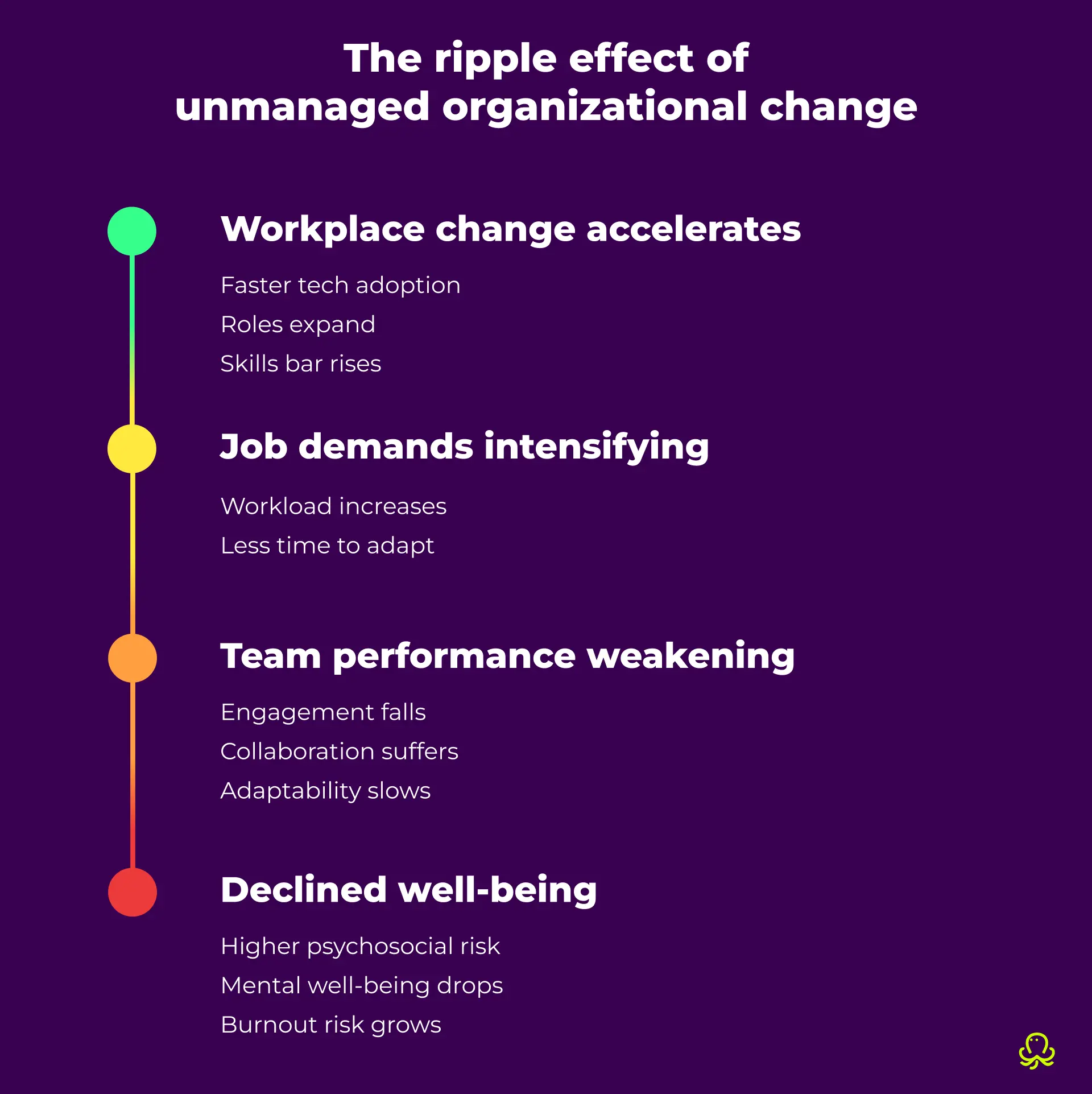
Change rarely affects only one person. When one employee struggles to keep up, the entire team feels the impact. Colleagues cover skill gaps, deadlines slip, frustration grows, and some disengage or leave. Over time, this strain destabilizes performance in ways hiring alone cannot repair.
The objective is not to push individuals harder. Organizations must design systems where continuous learning stabilizes teams, even as external demands continue to intensify.
Excessive approval layers slow the development of a corporate learning culture and prevent promising ideas from gaining traction. Strong programs begin with dialogue. Leaders must listen to the people who perform the work daily and understand where skill gaps and opportunities truly exist. This requires setting aside hierarchy when necessary and challenging routines that no longer serve the organization.
Designing a learning culture demands structure as well as intent. Clear ownership, defined responsibilities, and transparent processes ensure that initiatives move beyond good intentions. Teams must understand who leads learning efforts, how progress is evaluated, and how development connects to broader business objectives. Without coordination, even well-designed programs lose momentum.
Balance determines long-term success. Leaders should give employees room to experiment, reflect, and develop new capabilities. At the same time, they must establish a framework that aligns learning initiatives with strategic priorities.
The following sections outline practical steps organizations can take to build and sustain a strong learning culture.
Before launching new learning initiatives, organizations should assess existing capabilities. When teams overlook competency gaps, projects stall, errors increase, and performance suffers. They must also identify emerging skills that future roles will require. Early identification prevents reactive hiring and reduces strategic blind spots.
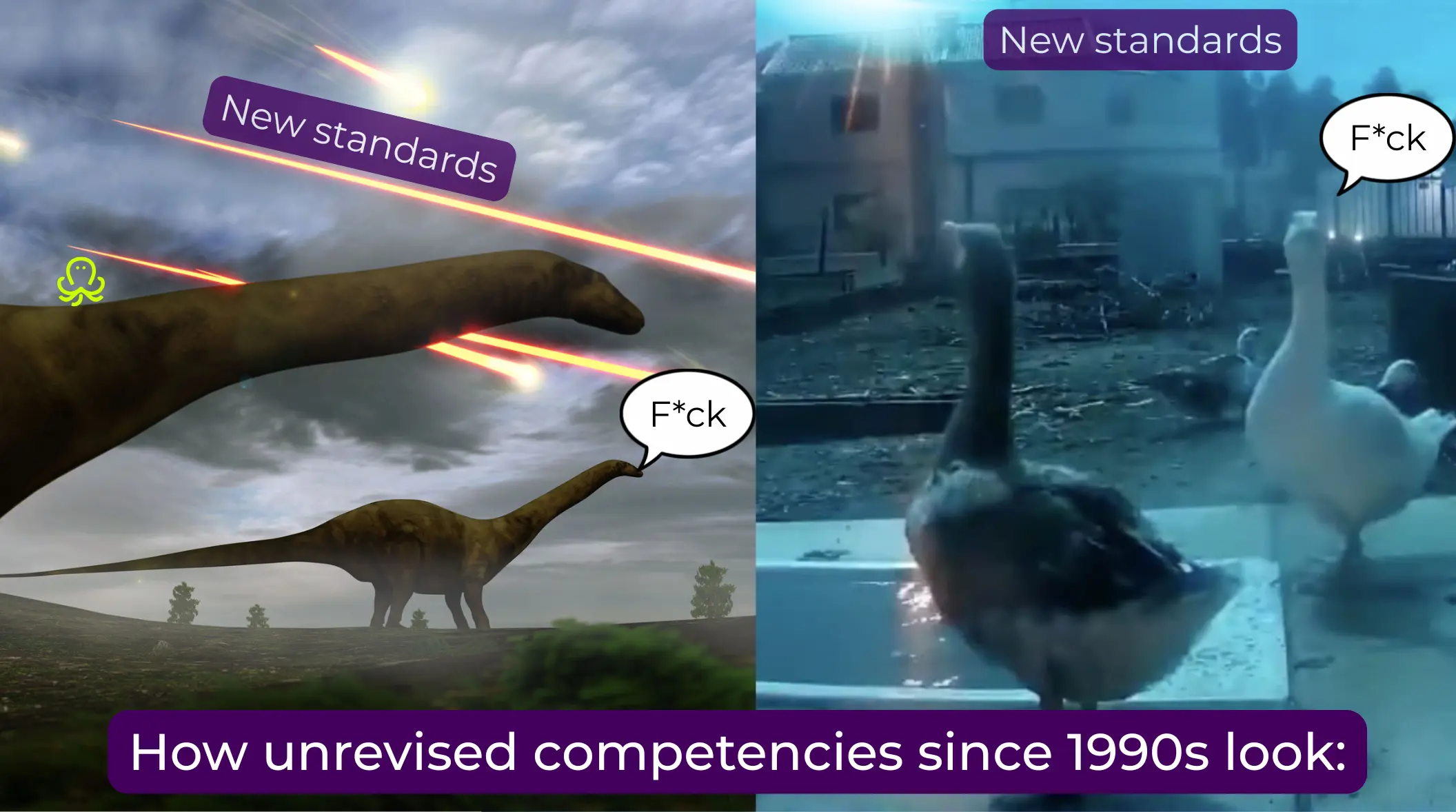
A competency matrix provides a structured way to map current strengths and capability gaps. It clarifies what employees know, which technical and behavioral skills they apply, and where development must occur. When designing the matrix, decision-makers should consider how teams collaborate with stakeholders, adapt to changing conditions, and make decisions under pressure. This broader perspective ensures the framework reflects real operational demands rather than theoretical expectations.
For example, the Alberta Competency Matrix and Definitions Library outlines foundational and transferable skills such as critical thinking, defined as identifying gaps and providing constructive feedback. It also emphasizes effective communication, such as explaining ideas clearly, and decision-making, which involves evaluating options and acting with confidence.
Regular reviews keep competency frameworks relevant. Updating learning priorities based on measurable skill gaps ensures development efforts remain aligned with team needs and strategic objectives.
Upskilling strengthens workforce expertise, closes competency gaps, and prepares employees for evolving roles. When organizations expect individuals to master new tools or responsibilities without structured support, performance declines and confidence erodes.
Companies can implement internal upskilling programs that track measurable progress and align skill development with proctored assessment standards where appropriate. Others may partner with external providers to deliver specialized training. In both cases, organizations should recognize learning as work by allocating time and compensation accordingly.
IBM notes that effective upskilling initiatives should match organizational strategy and industry trends. According to Gitnux, 91% of companies report increased productivity after implementing structured upskilling programs, reinforcing the link between targeted development and measurable outcomes.
Formal programs remain important, but individuals also contribute to their own growth. Self-directed learning, supported by accessible digital platforms and peer communities, encourages initiative and long-term engagement. As discussed in our article on reskilling and upskilling: why flexible learning matters for modern workers, flexible development models help organizations adapt to shifting skill demands while maintaining employee motivation. When employees choose to expand their skills, development becomes part of professional identity rather than a compliance exercise.
Organizations should formally recognize and support these efforts to reinforce learning as a valued and ongoing practice.
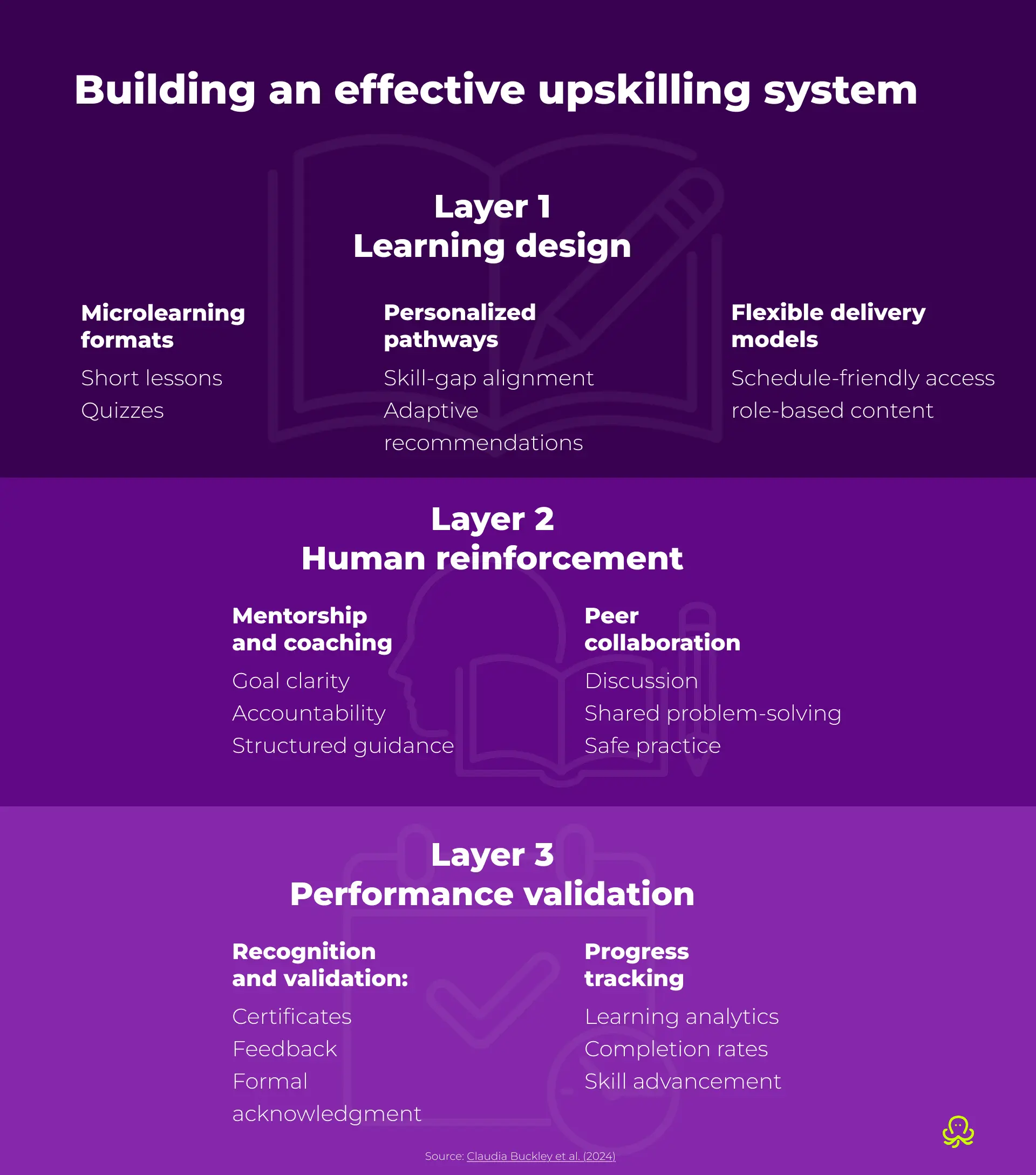
Reskilling enables organizations to transition existing talent into new roles as business needs evolve. In many cases, retraining current staff proves faster and more cost-effective than external hiring. Employees who already understand internal processes, culture, and systems adapt more quickly to expanded responsibilities.
Research by Mahedi Asan et al. indicates that reskilling efforts succeed when organizations provide structured support and adequate resources. The study also highlights the role of leadership in promoting continuous learning in the workplace, noting that visible encouragement strengthens adaptability and responsiveness across teams.
LinkedIn Learning reinforces this view. Flexible reskilling pathways, aligned with clearly identified competency gaps, help professionals develop the expertise required to meet shifting job demands. When organizations tailor reskilling initiatives to strategic priorities, they preserve institutional knowledge while maintaining competitive momentum.
Some organizations approach training primarily as a compliance requirement. They invest in development only when regulations, audits, or external standards demand documented proof. This reactive model prioritizes short-term certification over long-term capability building.
A compliance-only approach limits professional growth. It leaves talent underprepared for advancement and, in some cases, moves individuals into roles without sufficient skill development. Over time, this gap weakens succession planning and reduces organizational resilience.
Sustainable growth requires a different mindset. Organizations must embed learning into daily operations rather than treating it as a regulatory checkbox. Recognizing effort, rewarding development, and prioritizing learnability create a workforce prepared to take on new responsibilities and contribute at a higher level.
Leaders should actively gather feedback on what makes daily work faster, easier, or more effective. Employees often develop practical improvements (whether through tools, workflows, communication styles, or scheduling adjustments) that remain informal and unrecognized.
Organizations must create space for experimentation without penalizing unconventional thinking. When leadership recognizes successful initiatives and shares effective practices more broadly, innovation scales across departments rather than remaining isolated.
Open communication strengthens collective learning. Teams refine processes together, reduce repeated mistakes, and reinforce a culture where initiative and knowledge sharing drive continuous improvement.
Many development initiatives stop at course completion without confirming whether participants have acquired new skills. Without verification, decision-makers lack clear evidence of training effectiveness and cannot confidently link learning to performance outcomes.
A Forbes Business Council article outlines steps for verifying the effectiveness of employee learning, reinforcing the value of measuring outcomes rather than relying solely on participation. Similarly, Ben Rand argues in Harvard Business Review that well-structured training improves performance and can reduce unnecessary managerial oversight when organizations validate results properly.
Assessment plays a critical role in this process. Structured evaluations help determine whether knowledge translates into applied capability. Proctored exams add an extra layer of integrity by ensuring that results accurately reflect individual competence.
Organizations can choose live, automated, or hybrid proctoring models depending on their needs. At OctoProctor, we provide flexible proctoring solutions that support reliable verification while maintaining fairness and transparency.
Organizations should formally recognize individuals who create or share contributions that strengthen team performance or advance business objectives. Even incremental improvements deserve acknowledgment when they generate measurable impact. Clear criteria ensure that rewards remain transparent and equitable.
Recognition reinforces cultural priorities. When leadership highlights development efforts and knowledge sharing, it signals that learning drives organizational progress rather than serving as a peripheral activity. Visible acknowledgment encourages broader participation and embeds learning into daily operations.
A sustainable learning culture requires more than offering courses or scheduling training sessions. Organizations must assess competencies, invest in upskilling and reskilling, and align development with strategic priorities. Without systematically closing skill gaps, momentum slows and resilience weakens.
Development efforts also require verification. Measuring outcomes ensures that training translates into real capability rather than remaining a participation exercise. Secure proctored assessments provide credible evidence of progress and strengthen accountability.
Recognition completes the cycle. When leadership acknowledges meaningful contributions and supports thoughtful experimentation, teams respond more confidently to change. Together, these practices reinforce performance, adaptability, and long-term organizational stability.
Validate employee development and measure the true impact of your continuous learning programs through secure proctored assessments. We offer live, AI or automated, and hybrid proctoring solutions designed to support reliable skill verification while maintaining fairness and flexibility. 🐙
Talk to usContinuous learning refers to the ongoing development of skills and knowledge throughout a professional’s career. A strong learning culture emerges when organizations integrate development into everyday operations through clear structure, consistent support, and meaningful recognition.
In this environment, development becomes part of how work is performed rather than an occasional initiative. Teams adapt continuously, refine their expertise, and align growth with organizational objectives.
Continuous learning strengthens more than individual skill sets. Organizations that embed development into daily operations often experience:
When development becomes part of routine work, teams remain competitive and better prepared to respond to evolving demands.
Proctored assessments provide verified evidence of skill acquisition and training effectiveness. Instead of relying on course completion alone, organizations can confirm that participants demonstrate measurable competence.
OctoProctor supports live, automated, and hybrid proctoring models that enable secure identity verification, monitoring, and fraud prevention. These tools help organizations maintain fairness, integrity, and credibility when validating workforce skills at any scale.


Most assessments still reward one version of normal. This article shows what neurodiverse-inclusive design looks like: test-taker exam agency, low-stakes continuous testing, and timely feedback that teaches. It also names what fails and where remote proctoring can help, if humanely built.
Highlighting how OctoProctor’s latest proctoring update strengthens safe exam protection, improves administrator accessibility, and enhances reliability across the proctoring platform. All while preserving the simplicity of fully browser-based online proctoring.