Even the title sounds horrible, right? And yet most of us experienced exclusion to some extent, regardless of whether you consider yourself as neurodiverse or special needs. Modernity sells being included as simply showing up, playing by the rules, and the system will see you, respect you, understand you. That promise quietly assumes one thing: that you already match the system’s idea of “normal”.

And “normal” here is not neutral. In fact, it is never neutral. Colonial education was built to sort people into those who belong and those who must be reshaped or pushed aside. Karaoulas shows how colonial schooling was designed around the needs of the metropole, using language and curriculum to create compliant subjects and a small, “useful” elite, while everyone else was treated as surplus. Those logics didn’t magically vanish with formal decolonisation. You cannot decolonize a system with a mere snap of the fingers; coloniality will linger for decades in identities and epistemological structures. Colonial logics were simply updated and exported into today’s global education systems.
Thus, Chapman traces how capitalist education and science built an “empire of normality” that measures every mind against a narrow productivity template, pathologising those who don’t fit. For Indigenous and neurodivergent students, these layers stack. Johansson shows how a Eurocentric medical model treats neurodivergence as a problem to fix, while Indigenous perspectives often see autistic or ADHD ways of being as specific gifts – a spiritual way of life, not a defect.
When we discuss exclusion in education, we are not referring solely to individual bad teachers or underfunded support offices. We are talking about a long-running project that turned one very particular earning into the benchmark for everyone else – and called it universal.
Neurodiversity begins with a simple yet radical claim: there is no single right way to think, learn, or behave. It describes the full range of how human brains process information, with neurodivergent and neurotypical minds all under the same umbrella. Neurodivergent is a community term for people whose brains develop or function differently from the statistical majority, bringing different strengths and challenges, sometimes with a diagnosis and sometimes without one. Meaning, understanding and accommodations should not orientalize or be performatively based only on a doctor’s note.
Source: Doyle, 2020
The Australian Disability Network’s “spiky profile” depicts neurotypical performance like a fairly flat line, while neurodivergent profiles spike up and down. The problem is that most schooling still expects the flat line. A neurodiversity approach asks us to treat those who excel in some areas and struggle in others as normal human variation. Australian Disability Network calls this a “non-pathologising” frame that clashes with systems built around diagnosis and deficit. Naomi Fisher argues that, in education, this means flipping the usual script: individual differences are the starting point, not an afterthought once the standardized system has been rolled out. Instead of asking “what’s wrong with this learner?” educators should ask “what about this timetable, noise level, task design or assessment format makes their strengths hard to show?” A neurodiversity-affirming classroom is one where lecturers analyse and act on what learners in front of them actually need, rather than forcing everyone through the same narrow gate.
Supports like visual schedules, movement breaks, quiet corners, noise-cancelling headphones, and trained educators who help students decode behaviour rather than punish help everyone, but are non-negotiable for many neurodivergent learners. For assessment design, this shift is decisive. If we keep treating attention, processing speed, neat handwriting, quiet bodies, and linear essays as the unquestioned gold standard, we are not measuring ability. A 90-minute, 60 multiple-choice question exam measures conformity to a colonial, productivity-centred idea of how a “good mind” should behave. A neurodiverse learning lens asks a different question: what mix of formats, timing, scaffolds, and environments would let that spiky profile show its actual competence, not just its friction with the system?

Here’s the thing: not every accommodated exam is a win. More often than not, tertiary education institutions lack a culture of neurodiverse learning, and, on many levels, everything is done for compliance and accreditation QA. Which neurodivergent-affirming assessment design approaches work? Here are my three simple suggestions:
Good assessment for neurodivergent students starts long before the accommodations paperwork. Thus, inclusive instructional design and Universal Design for Learning (UDL) treat cognitive differences as a design parameter. That means building in multiple ways to access tasks and show understanding: varied forms of representation, options for action and expression, and deliberate work on engagement from the outset. In practice, this looks like flexible formats and pacing. UDL-informed assessment design for exams and assignments includes:
For many neurodivergent students, these features reduce cognitive load and anxiety enough that they can actually show what they know instead of fighting the format, including through cheating.
Assessment patterns also matter. I am sure you have heard about the continuous assessment principle. Work from the TESTA project shows that students learn more when they follow a regular rhythm of low-stakes or ungraded tasks, with feedback that clearly informs the next assignment, and a limited, predictable range of task types. That pattern is especially supportive for students with ADHD, dyslexia, or autistic processing differences, who benefit from distributed effort, repeated practice with familiar formats, and time to internalize standards rather than deciphering a new assessment genre every few weeks.
Finally, the “how” of assessment is as important as the “what.” In my story, I shared how cheating was prompted by inadequate pedagogy. The way exams were designed was an equal problem, but before I realized that rigid designs are not the universal truth, I primarily judged the hatred-based, hierarchical learning. Neurodiversity-informed reviews of Hamilton & Petty and Harrison et al emphasize compassionate pedagogy, flexible assessment formats, assistive technologies, and student voice in curriculum and policy design. The latest is what I would call a revolution, because it finally allows learners to reclaim agency in their education and ultimately ownership of their future. When neurodivergent students help shape rubrics and integrity policies, institutions move from simply granting adjustments towards epistemic plurality that colonial education design denies. Academia's acceptance of the many legitimate ways to organize knowledge and demonstrate expertise will help address the increasing dropout rates and the friction between real life and formal education.

Most of what fails neurodivergent students is still treated as rigorous in many universities. Oh, the rigor is often viciously defended by the purists, and whoever questions its painfulness is at best called low effort (hello from one!). Timed, text-heavy, high-stakes exams are an example of rigor. A notion of a 75% total grade, theory-only final without an adequate study guide, where I needed to guess what from an entire semester of lectures plus a 500-page “reading material” book will appear on the exam still boils my blood. Eaton’s review links these formats to ableist assumptions about speed, endurance, and written fluency, showing how they systematically disadvantage students with autistic processing styles, ADHD, dyslexia, or anxiety. Even when extra time is theoretically available, the default design still communicates that the model student is fast, calm, and, of course, neurotypical.
Assessment patterns designed only for institutional accreditation are the bane. TESTA highlights designs characterized by summative grading, minimal formative practice or low-level tasks, feedback that arrives too late to be reused, and an overabundance of unrelated assignment types.
For neurodivergent learners, executive-function load unrelated assignments create is counterproductive. New instructions every time confuse and stress. A bundle of essay, presentation, quiz and two exams fail to establish clear priorities without succession.
Such an assessment approach creates little chance to build mastery in any one form of academic communication, and it yet again concerns everyone. The result is a sense that assessment is an obstacle course rather than a learning tool. And what happens when there is a glorified obstacle? People either learn to conform in silence or bypass it. No wonder exams are either inefficient at measuring learning progress or become a psychological trauma for a lifetime.
Another big faultline is feedback that looks busy but goes nowhere. I like Dawson’s “feedback cannon” analogy, especially in the age of AI. University staff fire off pages of comments that are either:
Brown and Sambell make the same point from a programme angle – feedback concentrated on final, high-weight tasks is almost pure post-mortem. For neurodivergent students, who often rely on explicit cues and rehearsal to build new strategies, this is lethal. They get buried under red pen on work they can no longer change, while the earlier, safer moments when feedback could reshape habits pass by with little or no commentary.
Assessment cultures that cling to norm-referencing and “originality” myths reproduce ableist standards in subtler ways. Curved grading assumes a stable, homogeneous cohort and normalizes the idea that a fixed proportion must sit in each band, whatever their starting points or access needs. A, B, C, D, F with all their pluses and minuses – such grading creates classist segmentation within a classroom. You can try making grades private, but the test taker will still live with a narrow gradation of themselves.
I was a fan of CalArts’s approach to assessing student performance until I got more involved in education academically and lost my pink glasses. On my short visit to admissions tour, a philosophical question about “how we grade art” stuck with me – at the time I was finishing my film studies and felt that cinema is too subjective to grade if we wanted to find ourselves artistically. Looking back at CalArts grading options of High Pass, Pass, Low Pass, and No Credit are still quietly sorting people into a mini A–B–C–F, just with art-school lipstick. It keeps the same scarcity logic: a few students are “excellent,” most are “fine,” a slice are “barely acceptable,” and the rest are written off. That logic is exactly what Cain and colleagues dismantle in their review of traditional grading: letter-style tiers are poor measures of learning, distort motivation, and actively get in the way of useful feedback.
There are systems that collapse the hierarchy altogether. One is the plain pass/fail reform in medical education. A recent crossover study from Aalborg University followed several cohorts through a switch between numeric “tiered” grades and simple pass/fail for 4th–5th-year clinical exams. Changing to pass/fail did not reduce final licensing-exam performance, but it did redirect attention from rewarding the top performers to making sure struggling students actually met the standard. Combined with earlier evidence that pass/fail is linked to lower stress and less toxic competition in med school, that is a much stronger example of non-ranking assessment than a four-step pass scale that still encodes good/better/best.
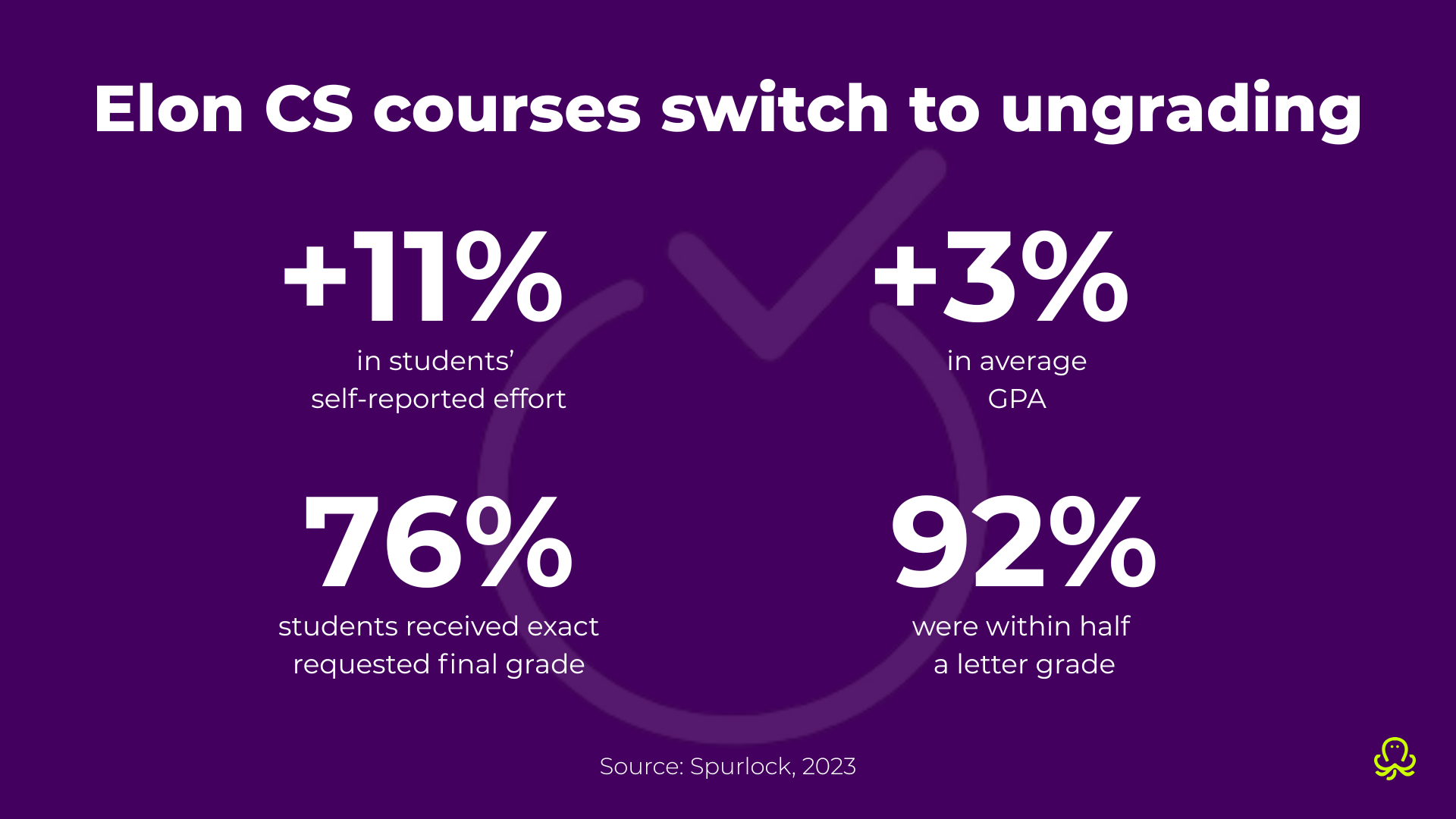
A second, more radical family comes from the “non-traditional (un)grading” camp. Romaskiewicz’s overview shows how contract grading, specifications grading, and full ungrading replace point-chasing with clear criteria, descriptive feedback and student agency. Many of these systems boil evaluation down to two tiers — pass/no pass or pass/revise – and put the nuance into narrative comments and revision cycles. Ungrading in particular shifts power: students self-assess in reflective process letters, negotiate their final grade, and spend most of the semester in feedback conversations instead of staring at a GPA. Measuring whether learner have mastered the outcomes, not how neatly they line up on a bell curve, is much closer to a neurodiversity-affirming ethic.
Neurodiversity-informed integrity scholars also point out how narrow our notion of “own work” remains: practices like scripting and collaborative planning are cast as suspicious, even when they are essential access strategies for neurodivergent students.
Finally, “accommodations as afterthought” remains a structural failure. Clouder et al. describe neurodiversity “cold spots” in higher education, where support offices exist but inflexible teaching and assessment approaches mean many students still cannot safely access them. Heavy documentation requirements, narrow notions of “legitimate” disability, and little flexibility for students who don’t yet have a diagnosis all filter out those who most need support. When assessment design begins with a narrow template of normality and then invites a minority to request exceptions, neurodivergent learners are positioned as problems to be managed rather than as participants whose ways of thinking belong in the classroom.
I intentionally left this hard question for dessert. Because my answer will be debatable academically and experientially, and it is ok. The act of proctoring was never designed to be neurodivergent-friendly.
The invigilator’s shoes click a slow, patient rhythm between the wooden desks, a thin shadow sliding across papers like a blade looking for its mark. Each time they pause, the room forgets to breathe. Pencils hover, throats tighten, and a single folded note feels suddenly as loud as a siren. Somewhere in the back row, a glance flickers too fast, and the invigilator turns as if they’d heard it.
Proctoring, the practice of invigilating students during exams, predates the internet. Modern proctoring you have in mind, however, may differ.
Let’s reckon, surveillance-heavy academic integrity practices are another pattern that can backfire. Eaton’s narrative review notes that AI-detection tools and remote proctoring both produce disproportionate false positives for neurodivergent and non-native English students, and describes e-proctoring as inherently ableist when it disrupts assistive technology and penalizes stimming or atypical gaze.

Indeed, systems still assume an “ideal test taker” sits still, keeps a steady gaze, stays in frame, and never needs to pause. For neurodivergent and disabled learners, that template turns normal self-regulation into “suspicious behaviour”: stimming, looking away to think, tics, self-talk, needing movement breaks, needing the bathroom, using assistive tech. When the monitoring model treats differences as risk, proctoring ceases to be a neutral wrapper around an exam and begins to shape who can perform under pressure.
But let me remind you of something. Behind every system, there is at least one human. Proctoring does not run by itself like a dystopian robot, picking one soul a day to write a random test – it follows the specific rules and metrics exam administrators input.
The harm is also cognitive load. If a learner spends the session managing the camera, responding to disruptive automatic alerts that narrate their movements, suppressing stimulants, and worrying about being misread, the exam becomes a performance of compliance rather than a measure of competence. Johanson describes cases where disabled students were penalized for disability-related eye movement, denied an interactive accommodation process, and pushed out of study pathways. That pattern indeed externalizes institutional anxiety about cheating onto the bodies of students who already carry more friction in standardized environments. Again, if you care about neurodiverse test takers, choose a vendor that allows you to juggle settings and system sensitivity, and voila, no disruptive automatic notifications.
Privacy, however, sharpens the question of remote proctoring. As someone with pronounced ADHD and visual stress markers, I would prefer writing exams in my safe space any time over commuting to a trip to university and sitting with dozens of others, stressing through their final showdowns. Jeez, stress is contagious! Disability services protect student confidentiality, and faculty are not entitled to diagnosis-level disclosure under FERPA, which is great… until the need for accommodation resurfaces, often a few days before a proctored exam. Remote proctoring can quietly collapse personal health boundaries, because the exam experience often forces learners to “explain themselves” to access basic accommodations (breaks, movement, assistive tools) or to avoid sanctions. If the only way to be treated fairly is to disclose medical needs repeatedly to proctors, platforms, or reviewers, then accommodations become exposure. The medical privacy conversation is honestly a hard one and depends a lot on institutional and state regulations. And in my opinion, there is absolutely no need to disclose conditions to the proctoring vendor or live proctors – a brief note in the specific exam rules is enough.
Where we place proctoring in a neurodiverse-inclusive design depends on whether proctoring adapts to the learner, or the learner is forced to adapt to the proctoring. A pro-accessibility setup means accommodations are built into the exam rules and enforced by the exam owner by default: pre-approved extended time and breaks, permission for off-screen regulation strategies, and clear parameters for what “movement” looks like when it is not cheating. Johanson is explicit that allowing administrators to integrate pre-approved accommodations (including unlimited breaks) can protect anonymity in a way that mirrors in-person practices. It also means real accessibility testing for assistive technologies and algorithms that do not treat gaze differences as misconduct by design.
Finally, proctoring can only be pro-neurodiversity when the exam itself is already designed with neurodiverse realities in mind. Modular sections, planned breaks, flexible timing, and tool access (text-to-speech, digital highlighting, speech-to-text, spell check where relevant) reduce the non-essential load so the assessment measures the target skill instead of stamina. Then, proctoring becomes a narrow integrity layer instead of a perceived behavioural regime. Training matters here too: reviewers need guidance to recognize false flags (lighting, camera angle, disability-related movement) and to escalate with care, not suspicion. If a vendor cannot support that flexibility and that training, the inclusive move is simple: provide an equivalent, dignity-preserving alternative assessment route, without making the learner pay for the institution’s tooling choices.
Ultimately, I can’t give you a conclusive path to neurodiverse classroom utopia now. As an education system, we have only begun to navigate decolonial learning methodologies. The results show a persistent disconnect between technological and educational advancements and their practical application for neurodivergent students, underscoring systemic barriers that remain despite progress.
Education needs to invite diverse stakeholders to the conversation, and OctoProctor is proud to be informed by teammates who are openly neurodivergent.
And to keep education accessible and mass, the industry may need to consider some temporary trade-offs as it keeps evolving.
Proctoring as part of assessment in hybrid or remote learning connects individuals with diverse needs to accredited educational pathways, and I think it is immensely valuable. Just think about how it was at the inception of remote learning – not as credible and definitely very inaccessible. Nonetheless, remote proctoring continues to open academic and corporate doors through virtual testing for neurodiverse learners. In many cases, accessibility during an online proctored test is easily ensured by the exam owner. Inclusion means using the loo when you need to, taking a snack to your exam, not being persecuted for dyslexia by being allowed spell checkers – all can be allowed by the institution by default.
Not all assessments need to be proctored. And in some cases, proctoring simply does not apply to one’s medical needs unless education forces them into disclosure battles. Meaning, methodologists and exam administrators need to think beyond the classroom box. Including sometimes means individualising. It matters, however, how one executes and presents such individual programs.
What’s important is that we, as educational practitioners, are building inclusive assessments for neurodiverse classrooms together, and this needs to become a culture. Only together can we offer a sustainable future for all.
Most proctoring tools were built for an imaginary “ideal learner.” OctoProctor lets you hard-code breaks, assistive tools, and flexible rules into the exam itself, so integrity stops fighting neurodiversity and starts protecting it. If you’re rethinking assessment for real classrooms, we’d love to help.
Talk to usDo not frame remote proctoring negatively. When you seed distrust and negative perception towards integrity – all students develop wary attitudes towards the invigilated assessment. Try to ground and introduce new things in a positive light via non-accusative language in manuals, docs, and forums.
A good example should be your approach to accommodations in remote exams, such as eliminating disruptive notifications, training proctors and writing their guidebooks in a way that does not vilify stimming and gaze inconsistencies, ensuring non-AI accessibility tools are allowed where relevant and design sessions with breaks by default.
Inclusive assessment treats neurodiversity as normal human variation, not a problem to work around. In practice, that means designing exams and assignments with flexible formats, predictable patterns, and clear rules so that attention, processing speed, handwriting, and “sitting still” aren’t secretly the main thing being tested.
Accommodations are often bolt-ons to an assessment that was never designed for diverse brains. Neurodiverse-affirming assessment starts earlier: universal design, modular exams, built-in breaks, assistive tech allowed by default, and clear language about what counts as misconduct. Individual accommodations still matter, but they sit atop a system that is already less hostile, so fewer students have to beg to be “exceptions.”
The usual villains are high-stakes, time-limited, text-heavy exams without clear study guides; chaotic assessment calendars; and feedback that arrives only at the post-mortem stage. Curved grading and fine-grained letter tiers add another layer of classism by rewarding prior advantage and competition. Together, these patterns measure exam stamina and background stability more than actual learning.
Think fewer task types, repeated often; small, regular checks instead of one giant final; and feedback that students can actually use on the next piece of work. Rubrics are transparent, examples are shared, and students know which skills each task is meant to surface. Pass/fail or specs-style grading focuses on “have you met the standard yet?” rather than slicing everyone into A- minus vs B-plus.
Start by fixing the exam design: shorter sections, planned breaks, flexible timing, and allowed assistive tools. Then configure proctoring so movement, gaze differences, stimming, and screen-reader use are not auto-flagged as suspicious. Accommodations should be encoded in rules and platform settings before exam day.
Pick one program or large gateway course and run a small, honest audit: which assessments genuinely measure learning outcomes, and which mostly measure endurance or admin convenience? From there, pilot small changes: simpler patterns, clearer rubrics, a one-pass/fail or specs-graded component, a calmer remote exam setup, and the collection of student and staff feedback. Transition is not an overnight event.


Highlighting how OctoProctor’s latest proctoring update strengthens safe exam protection, improves administrator accessibility, and enhances reliability across the proctoring platform. All while preserving the simplicity of fully browser-based online proctoring.