Choosing the right live proctors keeps exams fair, secure, and smooth. Whether you hire internally or work with an external service, you need clearly defined skills, responsibilities, and ethical standards. Structured job descriptions, screening, and evaluation help build a dependable proctoring team.
Online exams offer flexibility, but they also introduce challenges. Without someone supervising the test, even well-designed assessments can become stressful or unfair for students. This is why having a live proctor monitor the exam environment is so important.
Automated tools can support exam integrity management, but they don’t always get it right. AI tools may misinterpret normal student behaviour as suspicious or overlook subtle cues because they cannot reliably read human actions. Human proctors bring context, judgment, and reassurance that AI alone cannot provide. Their presence keeps the exam fair, accurate, and trustworthy.
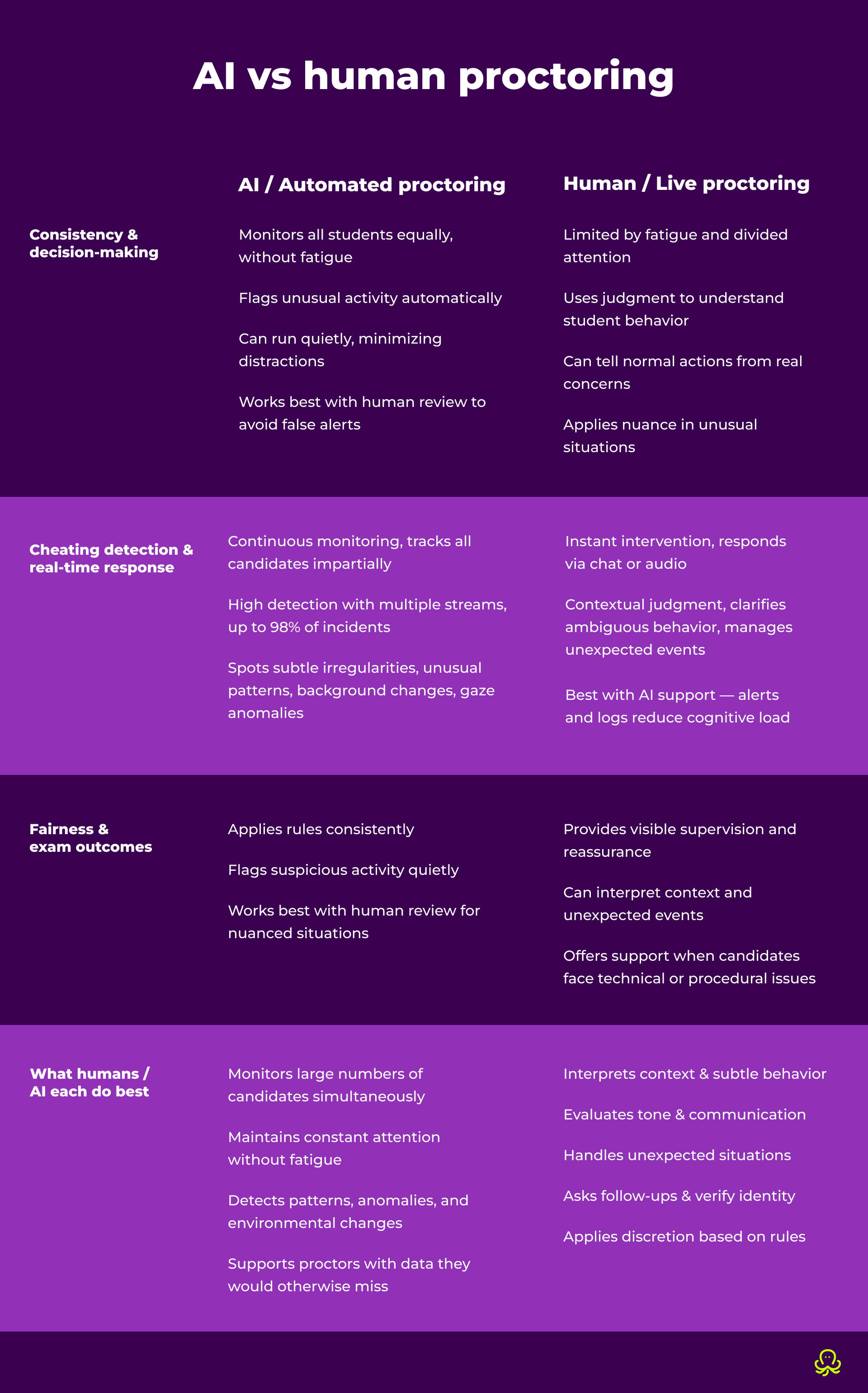
Still, deciding when to use live proctors isn’t always straightforward. Not every exam requires them: some assessments are low-stakes or simple, while others carry higher risk, difficulty, or regulatory expectations. This leads to the key question: which exams truly require live proctoring?
Live proctoring means a real person supervises an online exam through a webcam, screen share, or audio. Unlike automated systems, a human proctor can verify identities, notice unusual behavior, and respond to unexpected issues in real time. It requires some coordination, but it offers a level of judgment and reassurance that automated systems cannot match.
In most cases, the need for a live invigilator depends on the stakes of the assessment. Proctoring for academic institutions is most common in high-value exams such as finals, midterms, admission tests, and major online assessments where fairness, security, and compliance matter. These situations require human oversight to ensure every result reflects a student’s own ability.
Certification programs follow a similar pattern. Many credentials that lead to professional licenses, including CPA, PMP, or nursing qualifications, often require live supervision to protect exam integrity and maintain strict industry expectations.
Businesses and public-sector organizations also rely on live proctors. Companies use them for compliance checks, internal certification, and security-related assessments, while government offices use them to ensure equal treatment and prevent any form of misconduct. Even large online learning platforms and MOOCs now use live proctoring for their verified assessments.
In short, live proctors are essential for high-stakes exam supervision and for situations where institutions need to apply live proctoring best practices. Knowing when to bring in live exam monitoring staff helps schools and organizations hire the right proctors and go through the proper steps for selecting live proctors.
Finding qualified live proctors begins with understanding the available sourcing options. Many institutions recruit their own staff — often non-teaching employees — to supervise exams. This approach gives programs full control over scheduling, training, and proctoring staff selection, making it a strong option for internal or recurring assessments.

Other organizations choose to outsource live proctors through third-party providers. These may include specialized staffing agencies, call center teams trained in exam supervision, or a dedicated live proctoring service provider offering fully managed solutions. Outsourcing saves time and provides wider coverage across multiple time zones, though it offers less direct oversight of individual proctors.
Some institutions also work directly with proctoring software companies that supply trained proctors as part of their broader service proposition. This simplifies operations for large-scale or frequent assessments because the software handles scheduling, monitoring, and reporting. To learn more about how live proctoring works in general, visit our live proctoring overview.
Finally, live proctoring for certification centers is typically conducted by proctors who are hired specifically to supervise high-stakes exams. The same applies to testing centers, where proctors receive focused training and follow a clearly defined live proctor job description to ensure consistent, compliant oversight.
Whichever option you choose, understanding where to find qualified live proctors helps maintain secure, reliable exams and supports strong assessment standards.
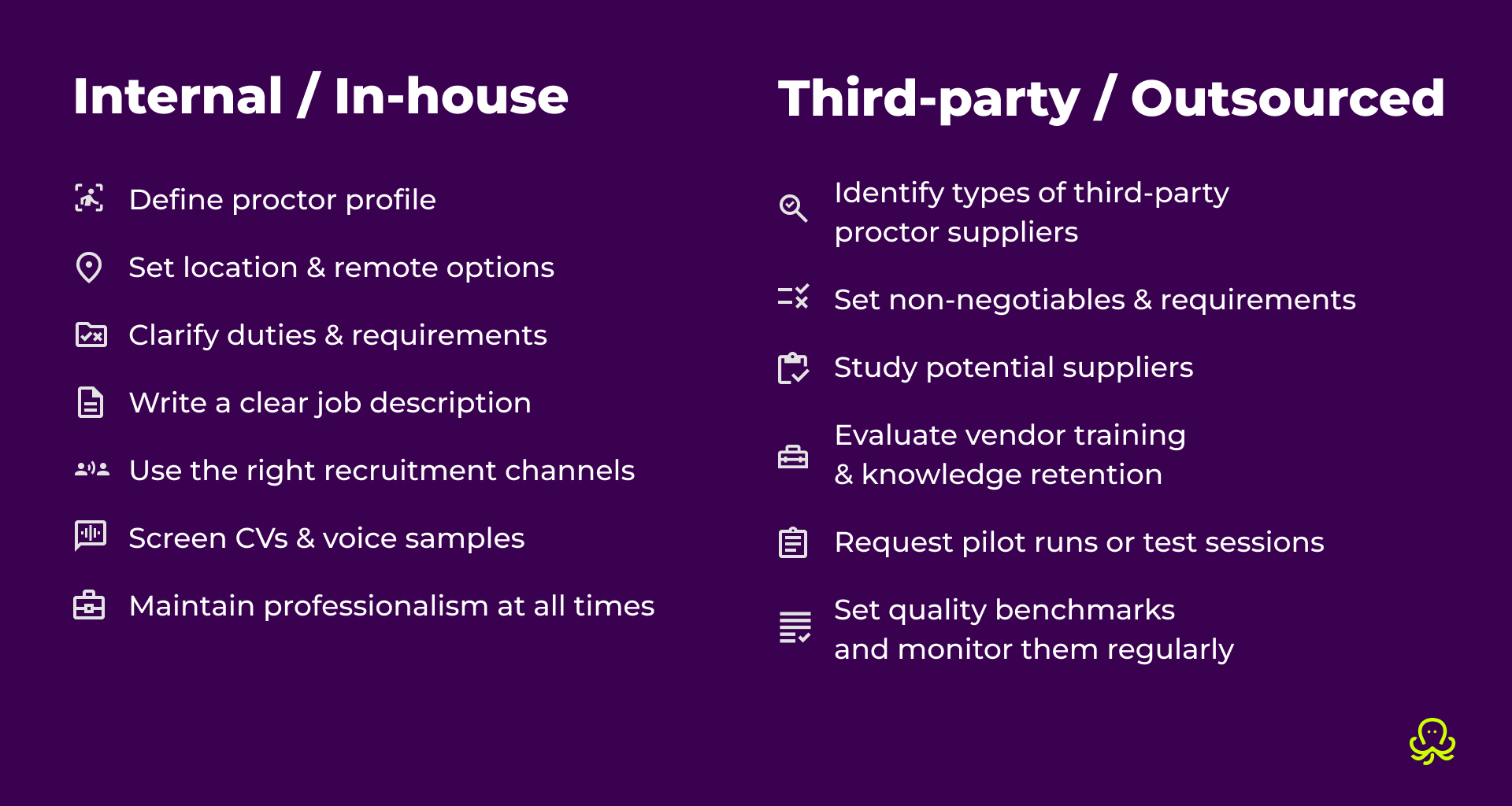
Selecting the right live proctors is essential for supporting exam compliance and fairness. The first and most important decision is whether you will hire proctors internally or rely on a third-party provider. Once that choice is clear, the next step is to follow the practical actions and considerations involved in selecting, evaluating, and onboarding qualified live proctors.
Let’s look at the steps required to build an effective proctoring team.
Begin by outlining the type of person you need supervising your exams. Think about their background (such as customer service, testing centers, or academic support), their temperament (calm, impartial, attentive), and their work habits. If you require background checks, specify what would disqualify a candidate. A clear profile makes selecting live proctors much easier.
Next, determine where your proctors can legally and practically be based. Some exams must be supervised within the same country for regulatory reasons. Others allow you to hire internationally, which broadens your candidate pool, reduces cost, and helps you cover multiple time zones. Knowing these rules upfront prevents delays in your hiring process.
Define exactly what you expect your live proctors to do before you begin recruiting. Start by outlining their core duties: monitoring the exam session, verifying identity, documenting incidents clearly, escalating issues according to protocol, and communicating with test takers in a calm and neutral manner. List the baseline skills as well — sound judgment, attention to detail, professionalism, and strong technical proficiency.
Just as important as the duties is the ethics code your proctors must follow. This should address acceptable conduct, confidentiality rules, communication boundaries, and strict limits on physical or visual checks. Strong ethical standards protect both students and institutions. Reports of proctor misconduct have included inappropriate comments, sexual harassment, unapproved room scans, or contacting test takers outside the exam window — behaviour that can trigger legal action, loss of clients, and serious reputational harm.
Documented cases highlight how easily these issues can escalate. For example, Examity faced scrutiny after reports of invasive and unapproved proctor actions during ID checks, making students uncomfortable and raising privacy concerns. Incidents like this show why a defined ethics framework, proper training, and close oversight are essential. Even a single violation can undermine trust and create substantial institutional risk.
Make these expectations explicit from the start so candidates understand what is strictly prohibited, what communication is appropriate, and how to handle sensitive or uncertain situations. This sets a consistent professional foundation before training begins.
After defining responsibilities and ethics, reviewing practical examples can help new proctors understand the standards in context. OctoProctor shared several scenario-based examples on LinkedIn showing which types of proctor instructions are acceptable and which are not. These examples reinforce training, promote consistency, and help establish clear behavioural boundaries from day one.

A well-written job description sets expectations and attracts qualified candidates. Explain what the work involves, the expected schedule, the software and tools they will use, and your standards for professionalism and conduct. If proctors must interact with test takers by voice, request a short voice sample along with their CV. This helps you identify communication issues early, rather than discovering them during an exam.
Choose your posting channels based on how you plan to recruit. For external hiring, platforms such as Indeed, LinkedIn, and national job boards work well. For internal hiring, distribute the announcement through staff memos, your intranet, or HR newsletters. Matching the channel to your recruitment strategy makes it easier to find qualified candidates.
If you requested audio samples, review those first. Technical skills can be taught, but clarity, tone, and communication style matter heavily in live supervision. After reviewing voice samples, examine CVs to ensure candidates meet your must-have criteria. You will filter out many applicants at this stage, but the remaining group will be much more aligned with your needs.
Interview your strongest candidates through a short call to observe how they speak, respond, and carry themselves. This shows you more about reliability, professionalism, and calmness than a CV ever could. After interviewing, update your shortlist and extend offers to the most suitable candidates. This final step helps confirm whether candidates can stay steady during high-stakes exam supervision.
Now, if hiring and managing proctors internally feels too complex or time-consuming, you can use third-party services that supply trained live proctors. The next section explains how to work with these providers effectively.
Third-party proctoring suppliers generally provide the service rather than individual, dedicated proctors. Because their staff often rotate across multiple exams, institutions may have less control over who supervises each session. Choosing the right supplier depends on your exam requirements, budget, and how much remote testing oversight you want.
Third-party proctoring companies offer different ways to provide proctors, with varying levels of control, training, and support.
Some of the options are BPO/managed-service providers, which are large operations firms that manage staffing, scheduling, supervising, and quality assurance for proctors at scale, often 24/7 and in multiple languages. They usually work under service-level agreements rather than assigning specific named proctors, and they rotate staff in teams or “pods.”
This model offers broad coverage and flexibility, but it comes with common pitfalls:
False coverage promises: Staffing levels and coverage windows may not match what is advertised.

Some agencies specialize in recruiting invigilators and training them to use your tools and follow your procedures. Contracts are usually based on time-and-materials or pre-agreed capacity blocks. This option gives you more influence over training and expectations, though it also includes potential drawbacks:
Before choosing a third-party proctor provider, identify the standards your exams must uphold. Clarify the non-negotiable requirements that protect exam integrity, fairness, and compliance. Key areas to evaluate include:
Take some time to examine each provider closely. Review their public materials, assess whether their claims match your needs, and look for external feedback where available. Focus on providers whose operational practices genuinely support secure online exams, fair treatment of test takers, and reliable exam compliance. This early research helps you filter out weak candidates before entering deeper evaluation. Whenever possible, run a pilot engagement or mock exam to see their proctors in action before scaling up.
Selecting the right live proctors is one of the most effective ways to protect the academic integrity of online exams and maintain student trust. Live proctors play a central role in high-stakes exam supervision, certification test proctoring, and many other assessments. Their judgment, communication style, and professionalism shape the entire testing experience, and they are often the individuals students engage with most during an exam. Because of this, they also receive a large share of complaints when proctoring is handled poorly.
Hiring live proctors who demonstrate strong ethics, calm decision-making, and empathy creates a safer and more consistent exam environment. Whether your proctors come from an internal pool or an external service, the key is equipping them with clear expectations, training, and support so exam conditions remain fair for every test taker.
Take control of your online assessments with OctoProctor’s live proctoring platform. Discover how our tools help institutions oversee exams effectively, streamline proctor management, and maintain confidence in exam outcomes, without needing a large internal proctor team.
Talk to usYou can hire remote live proctors directly by writing a clear job description, screening CVs and voice samples, and conducting short interviews to assess communication and professionalism. Another option is to work with third-party services that supply trained remote proctors. In both cases, share your exam rules, procedures, and ethics expectations upfront so proctors know exactly what is required.
A strong live proctor remains calm under pressure, stays focused for long periods, and communicates neutrally with test takers. They must follow exam rules precisely, use sound judgment during unexpected situations, and maintain strict ethical boundaries to protect students and institutions.
Essential qualifications include clear communication skills, strong technical proficiency, and comfort navigating proctoring tools. Experience in education, testing environments, customer service, or compliance roles is helpful. Many institutions also require background checks to ensure trust and safety.
Outsourcing can simplify scheduling, provide multilingual or 24/7 coverage, and reduce administrative load. However, it may give you less control over training, consistency, and individual proctor behaviour. Institutions should compare costs, coverage, governance practices, and quality assurance before deciding.
A good live proctor job description outlines core duties (monitoring, identity checks, and incident reporting), required qualifications, ethics standards, technical requirements, schedule expectations, and communication guidelines. Clear descriptions help attract the right candidates and set expectations from day one.


How OctoProctor keeps MBA exams fair: We balance executive-level schedules, global cohorts, and academic integrity through science-based proctoring that verifies learning without burdening candidates or compromising fairness.