I have stopped calling it “post-COVID education.” Six years in, that label feels like calling electricity “post-candle lighting.” The pandemic was the trigger, but hybrid learning in higher education had not been entirely new. Universities have been experimenting with flexibility for decades: part-time degrees, evening classes, correspondence courses, and early forms of distance education. The idea that learning does not have to happen in one place, at one time, has been around for a while.
What changed is the scale and the expectation. What used to be an option is now infrastructure.
As someone who has spent more than two decades at the intersection of software and learning, I get to watch this shift from a rather privileged seat — close enough to the classrooms, close enough to the exam rooms, and close enough to the boardrooms where budgets are signed.
And what I see is a very interesting thing, as the digital transformation in higher education is rewriting three things at once:
If you look at hybrid education trends, blended learning in universities, and what we still lazily call the post-COVID model, they all point in the same direction. The future of universities is less about delivering lectures and more about designing learning experiences.
In this article, I want to share how I see that playing out, and — just as importantly, if not more — where I think we’re getting it wrong.
Somewhere between 2020 and now, home finally stopped being home. It became an office, a classroom, a gym, a place where people cried during performance reviews and then smiled at a webcam for a seminar fifteen minutes later. Everything, except a place to rest.
And one of the most underestimated shifts in hybrid learning is psychological and, increasingly, cultural. This one rarely makes it into hybrid learning reports, but I keep coming back to it. For higher education, this matters more than we admit.
What we often describe as flexibility is, in reality, a collapse of boundaries. And once those boundaries disappear, the experience of learning becomes deeply dependent on something we don’t control — the environment itself. Which brings us to a question we don’t ask often enough: “What does home actually mean across different contexts?”
A student who studies from home in Madrid is not having the same experience as a student studying from home in Seoul or Lagos. And so there is a deeper layer to this that we don’t always talk about enough — the cultural impact of hybrid education.
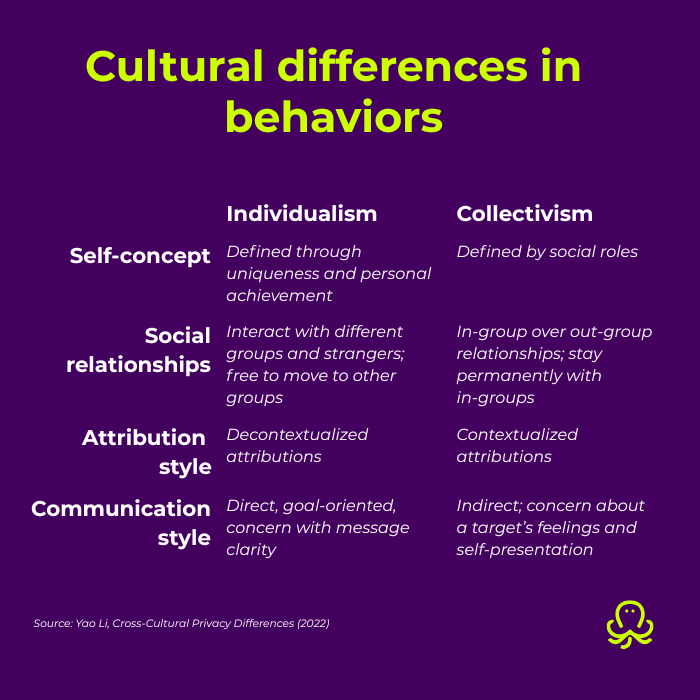
In more individualistic cultures, the home has long been treated as a personal territory. A controlled environment. A place where it is relatively easy to claim a desk, close a door, and call it a study zone. In more collectivist cultures, home is shared by design, both physically and socially. Grandparents, siblings, routines, expectations.
Research into cross-cultural privacy differences (for instance, Yao Li’s Cross-Cultural Privacy Differences) shows that while the need for privacy is universal, the way people regulate it is not. Across cultures, individuals are equally capable of creating boundaries, but the mechanisms differ. In some environments, privacy is enforced physically, through walls and distance. In others, it is maintained socially, through norms, etiquette, and unspoken rules.
In the digital context, these differences become even more visible. Studies show that attitudes toward personal data, visibility, and control vary significantly across regions — from stricter expectations around data ownership in parts of Europe, to more context-driven, socially regulated approaches in other parts of the world.
As Yao Li highlights in their research, most technologies are still designed with a “one-size-fits-all” privacy model, despite being used globally. The result is predictable: systems that technically work everywhere, but don’t always align with how people actually experience privacy in their everyday environments.
And this is exactly the tension we are now seeing in hybrid education.
Let’s take a live seminar. Or an online proctored exam that assumes: “Please ensure you are alone and undisturbed.” That assumption is not neutral. Of course, for some students, it works. But for others, it creates immediate friction.
And this is where things get uncomfortable, because we don’t always design for that reality. If we build hybrid models assuming every student has a private room, stable internet, and control over their environment, we are reinforcing a new layer of the digital divide in universities. We give the access, that’s alright, but we absolutely ignore the context.
This is also where student mental health in hybrid learning becomes more complex than just screen fatigue. Because the real pressure is the loss of boundaries, the inability to switch off, the constant overlap of roles, and the invisible negotiation over space: who gets the quiet chair, who gets the bandwidth, who gets to close the door. The truth is that home is not a neutral container. It has a culture and even its own politics.
The same applies to how people perceive visibility and monitoring (and when we talk about personalized learning environments, we tend to imagine control, don’t we?). In some contexts, individuals expect high control over their personal data and environment. In others, behavior is shaped more by social norms and group dynamics.
Which means that when we design online learning, remote assessments, or online proctoring, we are stepping into culturally shaped spaces with very different rules.
For some students, hybrid learning increases autonomy and comfort. For others, it introduces constant negotiation, reduced privacy, and pressure to perform in environments that were never designed for visibility.
So while hybrid learning definitely scales education, it amplifies what was already uneven. And if we ignore that, we risk building systems that technically work, but don’t actually work for people.
If students can reliably attend lectures online, why would they pay to sit in a 300-seat auditorium and listen to the same lecture in person? They would not. And they are not.
This is the part of the digital transformation in higher education that leadership teams cannot dodge much longer. The physical campus has to earn its keep. The institutions that are getting this right are converting lecture theatres into collaborative learning spaces, maker studios, and campus technology hubs — places that are harder to replicate at home on a laptop/mobile.
Group problem-solving, lab work, prototyping, peer critique, mentoring, networking, the weird hallway conversation that turns into a research partnership. That is what a modern campus is for.
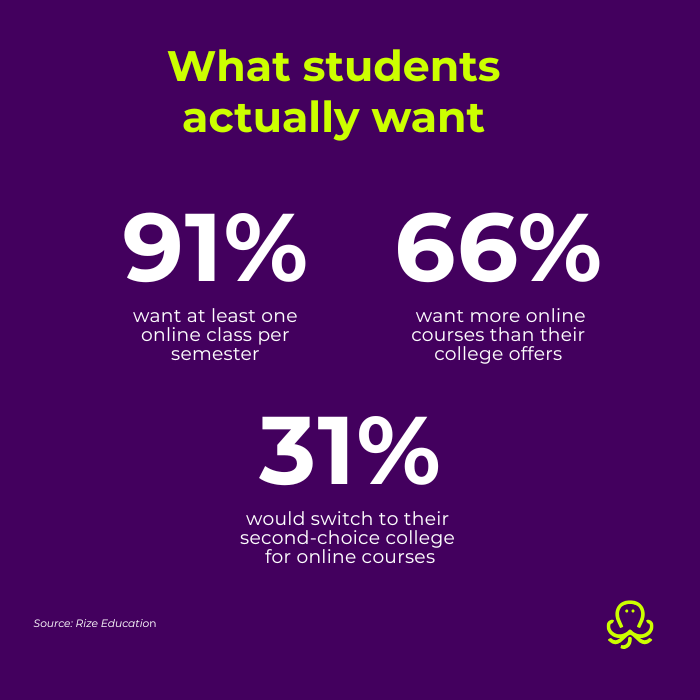
I want to be specific about something. I am not arguing for abolishing the classroom, I am arguing for ending its monopoly. A strong hybrid teaching model does not ask “online or on campus?” It asks “what is this session actually trying to achieve, and what is the best format for that?” Information transfer goes online. Practice, collaboration, and feedback-rich work go on campus. Most current timetables get this exactly backwards.
Here is where I am ready to plant a flag. Online learning platforms, when they are done thoughtfully, deliver more personalized learning experiences than a conventional face-to-face class with twenty to seventy students ever could. And I say that as someone who genuinely loves a good lecture.
The reason is boring and mathematical. A lecturer with seventy students has, at best, seconds of individual attention per student per session. Adaptive learning systems do not have that constraint. They track where each student stumbles, they adjust difficulty, they surface the explanation that works for this specific learner, they do it in real time, and they do not get tired by week eleven of the term.
There is a mental-health angle too, and it deserves more attention than it gets. Online assessments and remote classroom setups let students build personalized learning environments on their own terms — their desk, their lighting, their pace. For many students (neurodivergent ones, in particular), that alone can reduce a meaningful amount of background stress. And when the background stress drops, it makes space for something more useful. Which is focus. And with it, something we don’t talk about enough in assessment conversations — signal. What a student actually knows, what they actually understand, and how they actually think.
I know saying “hybrid saves money” sounds like a consultant’s slide. And in the current climate of sector-wide cuts in higher education, leadership teams are tempted to think that way (and the ugly truth about some consultants is that they certainly encourage it). But that framing is wrong. Because what hybrid actually reduces is not costs, it is waste.
Reducing campus overheads — unused lecture halls, underused buildings, heavy utilities bills, the maintenance that nobody sees but everybody pays for — frees (a bit of) capital that can be reinvested into what actually moves the needle: teaching quality, student support, remote learning infrastructure, accessibility.
Plus, a hybrid model allows universities to offer more programs to more students without a linear increase in physical footprint. Less required travel. Less dependency on fixed space. More intentional use of what remains. These are not abstract sustainability goals, they are measurable shifts in how resources are consumed.
Done well, hybrid learning model is also a step toward more sustainable education, because travel and paper consumption drop in ways that are easy to measure and hard to argue with. The caveat, and I want to be honest about this, is that hybrid done badly — like, recording lectures once and streaming them forever — erodes educational equity in the process.
The point is not to spend less on students. The point is to stop spending on infrastructure that no longer serves them, and redirect that money to things that do. And that’s what I call sustainable education.
If I had to compress everything I have said into one sentence: hybrid learning is shifting higher education from a logistics-driven model (fit the student to the building, the timetable, the exam hall) to a design-driven one (fit the learning experience to the student, the subject, and the outcome). Everything else — the campus rethink, the analytics, the assessment redesign, the AI debate — flows from that.
The benefits of hybrid learning for universities are real: better access, better personalization, better sustainability. The challenges of hybrid learning in higher education are equally real: cultural asymmetry, the erasure of home as a safe space, widening digital divides, lazy implementations that just digitize the worst habits of the old system.
I do not think the question is whether hybrid is the future of universities. The question is whether we rethink our systems — especially how we assess, how we support academic integrity, and how we balance accessibility with online assessment security — or whether we let those systems drift into their new shape by default.
I am a reformer, not a revolutionary (not any more;-)), so I would rather we did the slow, unglamorous work of getting it right. Dull, I know. Also, in my experience, the thing that actually works.
If you are rethinking your own institution’s hybrid model — or just arguing with a colleague about whether online assessments belong in your program — I would genuinely love to hear where you land. We are all figuring this out at the same time. Because hybrid learning doesn’t just change where education happens. It changes what education is.
If you're exploring remote assessments, online exams, or rethinking your assessment strategy, we’re happy to share what works (and what doesn’t) based on real-world implementations.
Let’s talk

A personal story of how Marina Detinko, our board member, went from questioning exams and systems to believing that proctoring protects fairness, access, and trust. This is not about control, it’s about building systems that actually help.