Remote proctoring has been around long enough to be considered standard infrastructure. Yet when conversations turn to data residency in remote proctoring, the mood often shifts from practical to — hmmm — slightly mythical.
We see it in RFPs. In audit checklists. In long email threads between compliance, IT, and procurement teams. Based on outdated assumptions about cloud data residency for online exams. Or on oversimplified interpretations of GDPR, FERPA, and other data legislation alike. The truth is less dramatic and way more useful.
So instead of fear-based narratives, let’s do something more productive. Let’s bust the most common data residency myths, explain how remote proctoring data residency actually works, and help you make infrastructure decisions based on reality, not folklore. Because data residency isn’t about restrictions, it’s about clarity, control, and informed choice.
Why this idea exists
Major cloud infrastructure providers offer strong performance regardless of region. A lot of remote proctoring platforms abstract the technical details so well, that institutions rarely see exactly where exam data is stored. It’s easy to assume location is just an implementation detail. Well, sometimes it is. Sometimes it isn’t.
A more balanced reality
For low-stakes exams, internal training, or globally distributed audiences, global cloud works perfectly well. For others, especially regulated or audited environments, online exam data residency becomes part of governance, not just infrastructure.
Institutions often need clarity around:
Just because transparency and control are part of responsible exam delivery.
What this means in practice
The key is transparency. Test organizers should know:
And — which is equally important — test organizers should be able to clearly communicate this to their stakeholders.
Takeaway
Cloud location may not always be critical, but it should never be unclear. Remote proctoring data residency itself is less about restrictions and more about informed choice.
Why this feels reasonable
Most data residency myths originate from privacy discussions around personally identifiable information (PII): names, IDs, or biometric data. So it’s natural to assume that everything else is operational and doesn’t fall under exam data residency requirements.
A more complete picture
Remote exam proctoring generates several types of data during an exam session, including:
Not all of this requires local storage. In many cases, global cloud data residency for online exams fully satisfies regulatory and institutional requirements. But some institutions prefer geo-specific cloud because it simplifies governance and audits.
What matters most isn’t splitting data across regions, it’s having a clear, consistent, and compliant data residency model.
Takeaway
Data residency decisions should reflect exam context, data sensitivity varies by exam type, audience, and policy. In practice, clarity and consistency are often more valuable than overly complex setups. Yes, clarity beats complexity.
Why people believe this
AI in remote proctoring is often seen as fully automated and independent of infrastructure performance.
What actually happens
Remote proctoring is a real-time experience relying on stable video and data transmission. The distance between test takers and cloud infrastructure can influence video stability, upload reliability, session continuity, etc.
That’s actually why we’ve been investing heavily in making OctoProctor resilient to real-world conditions, not just ideal ones. Our browser-based proctoring platform is designed to operate reliably even with unstable internet connections and bandwidth as low as 256 kbps, no matter what deployment option is chosen. This means fewer dropped sessions, fewer awkward “can you reconnect?” moments, and a smoother experience for both test takers and proctors, even in less-than-perfect network environments.
Important nuance
Well-designed global cloud infrastructure performs reliably in most scenarios. However, regional cloud hosting can improve performance when test takers are concentrated in specific geographies or network conditions are limited. Still, both global and geo-specific clouds can deliver strong results when the proctoring platform itself is designed for resilience.
Takeaway
Cloud region matters. Infrastructure resilience matters even more. The best remote proctoring platforms are built to maintain exam integrity and monitoring stability, regardless of network conditions, geography, or deployment model.
Why this seems true
Most test takers are focused on passing their exam, not cloud architecture. They worry about their answers, their results, overall exam fairness, their connection, etc. Not about data localization laws for education or cloud models.
Practical reality
Data residency becomes critical when institutions need to:
Clear institutional policies about remote proctoring data residency help maintain transparency and trust. Not because test takers demand it explicitly, though they do. But because trust in digital assessment depends on responsible governance.
Takeaway
Trust isn’t built on cloud location alone. It’s built on clarity, transparency, and consistent exam security practices. Clear communication matters more than the specific cloud model.

Why this works
Global cloud is efficient, scalable, and operationally simple. It’s often the right starting point, especially for international programs or distributed audiences. It supports fast deployment and reduces operational overhead.
Where flexibility helps
Institutional needs evolve. As they move on, organizations later might require:
And yes, let’s be honest, it’s 2026. We’re living in a world where regulations, geopolitical realities, and data localization expectations can shift quickly, so having flexibility in remote proctoring data residency is no longer just a technical detail. It’s a part of long-term risk management. That’s why OctoProctor supports multiple modes: global, geo-specific, or fully on-premise, because institutions need the ability to adapt.
Takeaway
Simplicity is valuable, but flexibility provides resilience.
When institutions evaluate remote proctoring data residency, the real question is rarely “global vs local.” It’s about fit. Fit with your exams. Fit with your policies. Fit with your future.
Instead of defaulting to assumptions, it helps to ask a few practical questions:
Data residency in remote proctoring is not a one-time decision. It’s part of a broader institutional data governance strategy.
Modern remote proctoring platforms increasingly support multiple cloud hosting models for EdTech, allowing institutions to align infrastructure with their operational and compliance needs. At OctoProctor, flexibility is built in from the start:
This is how we ensure institutions are never locked into a single cloud model. Instead, they can evolve their deployment as their needs evolve. Because remote proctoring compliance is not static, and your infrastructure shouldn’t be either.
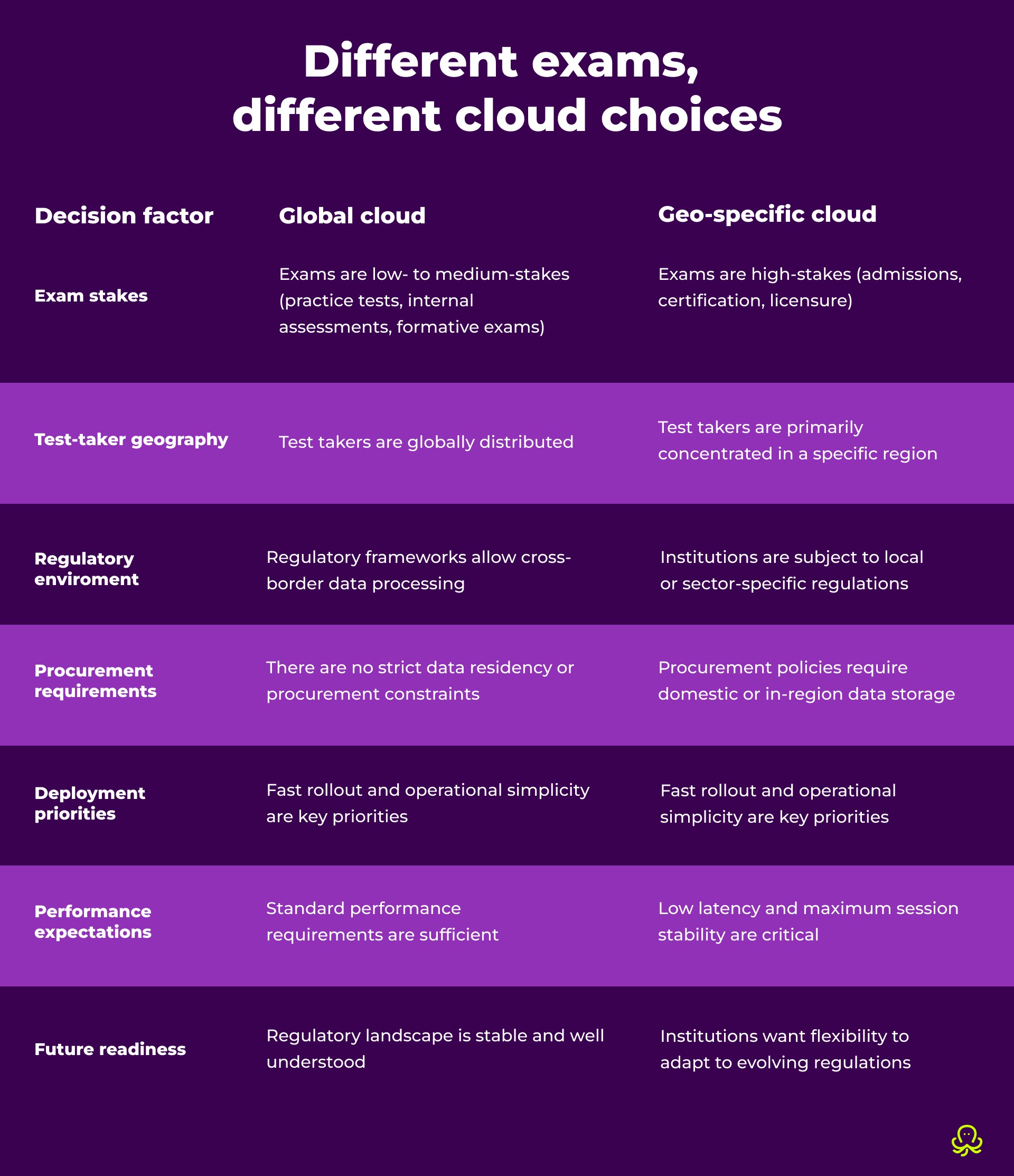
Different exam programs have different needs. A global certification body delivering exams across dozens of countries will have very different online exam data residency requirements than a national admissions authority operating within a single jurisdiction.
Many start with global cloud hosting because it enables fast rollout, operational simplicity, and immediate scalability. As exam programs grow, regulatory environments shift, or procurement requirements change, regional cloud infrastructure becomes more relevant.The table below illustrates where each cloud model typically fits best.
And yes, the best proctoring infrastructure is not defined by where it runs. It is defined by how well it aligns with the institutional needs of today and tomorrow.
There’s no universally correct place for proctored exam data to live. There’s only the place that makes sense for your exams, your test takers, your regulatory environment, and your level of risk tolerance.
Some teams start globally because it’s fast and practical. Others stay local because it makes compliance and governance simpler. Both approaches work. It’s not the cloud region itself causing problems. Problems usually appear when the cloud region wasn’t a decision at all, just something that happened along the way.
The good news is that this is not to last forever. Infrastructure can evolve. Requirements will evolve. The important part is choosing a setup you understand, can explain to stakeholders, and can adapt when needed.
Because in the end, exam integrity doesn’t come from picking the right country. It comes from knowing exactly what you’re doing and why.
Every institution’s compliance and infrastructure needs are different. We’ll help you choose the right deployment model — global, regional, or on-premise — to support your exam security, governance, and long-term flexibility.
Let’s talk!Data residency refers to the geographic location where exam data is stored and processed. In remote proctoring, this includes video recordings, identity verification data, and session monitoring information.
Remote proctoring data residency plays an important role in helping test organizers align with regulatory frameworks such as GDPR and FERPA, as well as internal data governance policies.
Beyond compliance, choosing the right cloud hosting model for remote proctoring also supports:
OctoProctor is designed to support these needs through flexible deployment options, allowing institutions to select the cloud region or on-premise model that best fits their compliance and operational environment.
Yes, remote proctoring can be fully GDPR compliant when implemented with appropriate safeguards, including secure cloud infrastructure, controlled access, and clear data governance policies.
OctoProctor’s platform is built with remote proctoring compliance in mind. Our EU cloud deployment supports GDPR requirements by ensuring that proctoring data can be stored and processed within European infrastructure, while providing institutions with control over access, retention, and data handling.
Proctoring data is typically stored in a secure cloud infrastructure. Many modern platforms allow institutions to choose between global cloud hosting and regional cloud infrastructure.
For instance, with OctoProctor, institutions have multiple options depending on their needs:
This flexible approach ensures our clients can align remote proctoring data residency with their regulatory, operational, and governance requirements, without changing platforms.
Retention periods vary depending on institutional policy, regulatory requirements, and exam type. Remote proctoring platforms, such as OctoProctor, enable institutions to configure data retention settings. We give our clients full control over exam data retention settings, allowing administrators to define how long proctoring data is stored and when it is deleted.


What’s no longer working in US undergrad admissions and where performative, AI-tinged essays and generic test scores fall short? The “local era” demands its correctives, and owning entrance exams can be the case for your institution.