My favorite revolution in EdTech in universities is academic performance analytics. Not the dashboard-for-the-sake-of-a-dashboard kind. The kind that gives a teacher, on Tuesday morning, a clear picture of which three concepts half the cohort did not actually understand last week, and lets them adjust Wednesday’s session accordingly. And this is exactly where educational technology in higher education stops being invisible infrastructure and starts shaping outcomes directly.
In a traditional classroom, that feedback loop takes weeks, sometimes a whole semester, and usually closes only after a final exam reveals the damage. Digital testing tools, well-integrated with the learning management system (LMS), shorten that loop dramatically. The teacher sees where comprehension is thin. The student sees where they are drifting. Nobody has to wait until the grade appears.
And once that feedback loop starts working in real time, something else begins to shift. Assessment stops feeling like a single high-stakes event at the end of the process. It becomes part of the process itself. Which, in practice, changes how students experience exams.
There is less of that compressed, performative pressure where everything depends on one moment, one setting, one version of yourself on a particular day. At the same time, the system itself becomes more responsive. With digital assessment and properly integrated tools, feedback is no longer something that arrives after the fact. It becomes part of the learning loop, adjusting pace, focus, and expectations while the course is still in motion. Which sounds like progress, and in many ways, it actually is.
But there is a condition attached to it. The moment you make assessment more flexible, more distributed, and less controlled, you are also making it more dependent on trust. And trust does not emerge automatically.
Because once exams move beyond the physical classroom, the question is no longer just how students perform — but whether that performance can be relied on. And here online exam integrity comes to the stage. If that part is not addressed carefully, all the gains — better feedback, lower stress, more meaningful outcomes — start to feel fragile.
This is where AI proctoring and other remote proctoring solutions come into play as a way to maintain trust in online exams. Because without trust, assessment loses meaning.
Assessment redesign is the part of this transition I am most excited about. And yes, it is long overdue. I absolutely do not miss the timed essay that rewarded fast handwriting over clear thinking (I’ve been hating those from my school days, and I’m still hating essays — the one you are currently reading was luckily not timed;-)). And I suspect I am not alone.
So, my favorite question is:
What are we actually trying to find out about a student, and is our assessment the shortest path to that answer?
Most of the time, the answer is no. Because for a very long time, assessment was built around constraints: limited time, limited access, limited space. You walked into a room, you showed your ID, you reproduced what you could remember, and you left. That model made sense in a closed-book world, and we do not live in that world anymore.
Students have access to the internet, various tools (AI included), and last but not least to each other. Trying to recreate the sealed exam hall in a student’s bedroom is a losing battle, and to be completely honest, a creepy one. A better approach is to redesign assessments so that open access is expected, and what you are measuring is how a student applies, synthesizes, critiques, and defends their thinking. Not to ask what a student can recall under pressure, but what they can do with what they know. That is a harder assessment to design. It is also a more honest one.
It might sound too bold, but I can definitely say that modern education doesn’t just require new tools. It requires assessment redesign. This includes:
And this is where the conversation inevitably circles back to academic integrity. The moment you open the environment, you also open the door shortcuts. This is the point where many institutions instinctively try to go backwards and to recreate control instead of redesigning around reality. I don’t think that works.
What does work is combining better assessment design with a lightweight layer of verification. This is where I put on my OctoProctor board-member hat for a moment, because it would be dishonest not to. AI proctoring and other forms of remote exam supervision do have a role in this ecosystem. But not as a surveillance apparatus. At least, not the way I believe they should be used.
At their best, they do three things:
That’s it. Accessible. Configurable. Non-intrusive. Used this way, proctoring stops competing with good assessment design and starts supporting it.
Because academic integrity in online learning is not about a conflict. Trying to preserve outdated models in a new environment is. Virtual classrooms and remote assessments do not have to mean compromised standards. They mean different standards. Standards that are better aligned with how people actually learn, think, and work today.
Let’s not pretend otherwise — the rise of AI in education has fundamentally changed how students approach assignments and exams. And we all see the results of the increased use of AI tools in education, shifts in writing style, challenges in verifying authorship, etc. This makes academic integrity in online learning a moving target.
The less a teacher knows a student personally — their phrasing, their habits, their slightly imperfect but very recognizable way of thinking on paper — the easier it becomes for that student to outsource their voice. Online education widens that distance by default, as it literally changes proximity. You simply do not get the same density of interaction. Fewer small signals. Fewer moments where you recognize a sentence and think, yes, that’s exactly how they would say it.
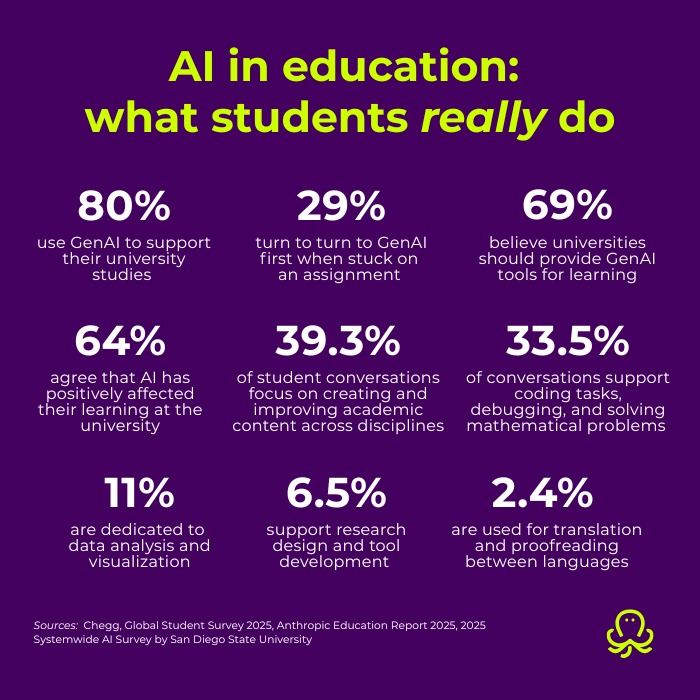
On one side, there is a growing instinct to tighten control. More detection, more restriction, more attempts to draw a hard line between “human” and “AI.” On the other, there is a realization that this line is already blurred. The tools are not going away, and neither is hybrid learning. It puts institutions in a slightly uncomfortable position. So trust — the thing that used to be implicit — now has to be constructed deliberately. Context. Continuity. A way to connect performance to a real person, in a system where that connection is no longer obvious. And without that, assessment becomes easier to manipulate and harder to believe in. And this is exactly why academic performance analytics and student performance online over time are becoming more important than any single submission. Because a perfect answer proves very little. A pattern does.
I don’t think digital assessment is about making exams easier or harder, it’s about making them more honest. More aligned with how students actually learn, think, and work today. More continuous. More contextual. Less dependent on a single moment.
That shift is more conceptual rather than technological. And like most meaningful changes in education, it’s slower, messier, and far less glamorous than the headlines suggest.
However, if we stay with it, and if we design with intention, it’s also where better outcomes (and more trustworthy ones!) come from.
We work with institutions designing secure online exams and assessment strategies that actually reflect how students learn today, not how they used to.
Let’s talk!