It is customary not to like cheaters, whether in corporate or personal life. While I am thankfully not a family counselor, OctoProctor has extensive expertise in academic and corporate cheating, which has plenty of shades.
Humans are socially constructed to view academic integrity as a trait that belongs only to good people; I beg to differ. It is common to see the world in black and white, especially when one has been wronged and hurt. I don’t believe it is healthy to oversimplify reality, as it prevents people and groups from recognizing the world’s complexity, nuance, and the many shades between extremes.
As experts in academic integrity, OctoProctor not only prevents cheating through online proctoring solutions but also works on establishing understanding between test takers and organizations through research and advocacy. That is why I will be uncovering the many shades of cheating to build a realistic perception of those who resort to dishonesty.
The majority of students and the workforce have experienced that terrifying moment during an exam – freezing up in panic, unable to recall information they had reviewed countless times, even just the night before.
.png)
The answer lingers at the edge of awareness, right on the tip of the tongue, but no amount of mental effort brings it into focus. As the clock ticks, panic rises, adrenaline spikes, and stress intensifies. Eventually, the student decides to move on to the next question, only to find themselves facing the same mental block. When the missing piece of knowledge finally resurfaces, they rush to fill in the answer — only to forget what they had just begun to tackle. In moments like these, it’s easy to think: if only there had been a crib note, this could have all been avoided.
It is essential to understand that crib notes, “sneaky” AI use, and fabrication are not the best long-term solutions. Severe stress, depression, a vitamin B12 deficiency, sleep deviation, some prescription drugs, and infections can all play a role in exam vexation.
And, well, just saying “don’t worry, be happy” would be a tone deaf one-size-fits-all. Exams have stakes. Additionally, some paperless exams are also less user-friendly than paper ones, which is a waste of potential.
A memory lapse occurs when an individual consistently struggles to recall things they could previously remember. Casual memory lapses are more common than people think and are less tragic than Alzheimer's or amnesia, just in case you run to PubMed or Google for a self-diagnosis spree. The sole reason one becomes hyperaware of their memory lapse is that it occurred at the wrong time.
What, however, binds “sudden” memory lapse during an exam with Alzheimer's and amnesia is a combination of genetic, lifestyle, and environmental factors that affect the brain over time.
Here are a few ways memory glitches can play out, especially during an online proctored exam:
A test taker may have studied thoroughly but still draw a blank during the exam. This often stems from a lack of focus during learning or recall. In a proctoring session, it might appear as excessive fidgeting, staring off-screen, or inconsistent eye movement – actions that automated systems could mistakenly flag as irregular.

Sometimes, a word or concept sits right on the edge of recall, but just won’t surface. This is known as blocking, and it’s often triggered by cognitive overload or anxiety. In real-time, this may appear as extended pauses on a question, repeatedly returning to the same item, or switching tabs too quickly – behaviors that might raise red flags during proctoring.
A learner may recall information but confuse its source or context—remembering a fact from one unit as if it belonged to another. This could lead to partially incorrect answers that, under certain conditions, resemble guessing or unauthorized assistance.

The natural decline of memory over time means that the longer ago a concept was learned, the harder it can be to recall under pressure. In timed exams, this fading effect may contribute to test anxiety and inconsistent performance, especially when recall slows under stress.
Memory is malleable. A test taker might unconsciously alter their memory based on new information or personal bias. In assessments, this could result in confidently submitted but factually inaccurate responses.
Led by such unsavory past experiences, many test takers resort to crib notes and other cheating methods to ensure they remember the relevant materials. The remote nature of the exam is even more tempting – it is easier to cheat in one's own home, hiding an extra phone, note, or even getting creative with hidden household members supplying results – the limit is only one’s imagination. That is, if the online exam is unproctored ;)
However, educators should take into account that in remote proctored settings, these moments of confusion, hesitation, or recall delay don’t always mean dishonesty, but they can appear as irregular behavior. That’s why human review should be paramount when a student is flagged. Of course, human proctors need to be trained to distinguish between suspicious activity and natural cognitive friction.
There is a stark difference between an educator and a good educator. Good educators are mission-driven and deeply care about their students' mental and physical well-being. And the care is reciprocal – students study better, carry the legacy of their favorite educator, and often return to help and support those who believed in and truly invested in them.
It is not only possible to make online proctored exams less stressful, but also to reduce memory lapses in general by following the tips I have compiled below.
It is easy to prioritize a high-stakes online exam over everyday life, including diet. People lose their appetite, become restless, and cooking might feel like an immense waste of time, even more so when sitting down for a proper meal, especially when there is a 12-week curriculum that needs to be revised.

Slurping plain ramen all the way through our studies is a shared experience across the world, but this tradition has to stop. Besides crazy amounts of sodium, fat, and fast carbs, there is nothing instant food can offer that your body needs for high-performing learning.
For example, vitamin B12 deficiency significantly impacts cognition. While it is generally an inexpensive supplement found in supermarkets and nutrition stores, moderation and doctor guidance are key. Harvard advocates that people with borderline kidney problems are better off staying safe than sorry because cyanocobalamin, synthetic B12, may impair kidney function.
Consider why test takers are so frightened of your assessment that they can’t find sufficient time to eat? Maybe you have exaggerated the exam stakes, your learning objectives were vague, or you were unnecessarily hard on the class?

Take a couple of minutes to remind test takers that, although plain ramen from a cup may seem like a good solution during intense study sessions, it is not a proper diet that will sustain complex brain activity. Yes, they are legally adults, but as if teens suddenly gain galactic wisdom at midnight when the law decides they can get married, vote, and smoke? Teens or young adults still learn the way of life, now confused and overwhelmed by all the new obligations, and some soft guidance will make a change.
Emphasize that it is good to take breaks and let the brain process, recharge, and consolidate new information while treating oneself to a meal.
Another tactic that students appreciate is allowing them to take a snack to the exam – a small chocolate bar goes a long way when it comes to fueling brains!
Studying for an online proctored exam should not be about closing oneself off in an academic silo. Firstly, we need fresh air. Sitting locked in a dull apartment without even opening a window will starve the brain of oxygen, resulting in declining efficiency during exam prep.
If the weather is nice, an outdoor study session on the balcony will provide sufficient fresh air and sunlight. Free vitamin D and less brain fog are still free, even in this economy.
Finally, adding light exercise or stretches between study blocks to boost blood flow will ease exam stress and keep burnout at bay. Fine motor skills have proven their efficiency in restoring cognitive function after strokes. According to Liou et al. (2020), hand fine motor skill disability correlates with dementia severity.
.png)
You can try an “outdoor” revision session with your face-to-face, remote, or hybrid class, especially during moderate autumns and springs. A shift in surroundings can help de-escalate stress, and observing other test takers study together can reduce FOMO.
You can also place reminders to take a break in the revision guide posted on the LMS – a short fact about vitamin D, a question about the weather outside, a comment about the importance of eye and finger exercises, etc. These short check-ins are a non-invasive way to show that, despite any stakes involved in the exam, you deeply care about your test takers.
FOMO will creep in during breaks, and the phone may seem like a logical entertainment. However, a phone is still a screen that strains the eyes. Furthermore, social media scrolling tampers with focus and may emotionally upset or not satisfy dopamine craving, resulting in users (especially those with ADHD) overconsuming content. Internet scrolling is a stimulation of the brain, while rest without screens counts as a recovery.

Distributing a prep reminder along with exam revision notes is a tasteful way of reiterating to avoid email, social media, or anything that overstimulates test taker brain. Sometimes, all that is needed to reduce exam panic is a small reminder to take care and a heads-up.
Memory, perception, reasoning, and pattern recognition are four skills that can be put to the test in brain training games and jigsaws. Starting one’s day with a mental exercise powers up cognitive function.
Furthermore, often high-stakes exams become a lonely road. But crosswords, sudoku, and board games are also highly beneficial for any age, so bringing the entire family together for a good break is a win-win :)
Sart lectures, study sessions, and exam revisions with a small mental warm-up tradition. It is a fun way to build class engagement and gradually immerse students in the daily agenda.
Likewise, you can start your proctored exam with a light quiz that resembles brain training games students have become accustomed to during class.
How effective would a night-before-studying marathon be if the test taker comes to an exam barely functioning and overly caffeinated? Because the brain is overstimulated and tired, it will struggle to recall and make more mistakes than if it had a good night’s sleep.
Moreover, taking a quick nap before an exam can help ease stress and boost cognitive abilities.
Test-takers don’t cram the night before for fun. They do it when learning objectives were unclear, when exam stakes were blown out of proportion, or – let’s be honest – when the course wasn’t taught effectively.
If it's the first case, write a proper exam study guide. It reduces overstudying and anxiety. For Olympiads or high-stakes assessments, providing a shorter-form mock exam (last year’s edition works great) helps students get familiar with online proctoring and reduces disorientation on test day.
If it's the second, stop fear-mongering. Exaggerating the importance of an exam might push a few to study harder, but it will push many more into panic-induced cheating. Humane motivation beats academic brinkmanship every time.
And if it’s the third, teach better. Begin each session with a quick recap and end with a clear, interactive summary. Doing so will make your class easier to follow, easier to remember, and much less likely to trigger last-minute cramming.
Well, well, well… didn’t expect this tip from a proctoring software blog, did you?
Writing crib notes by hand is brain science. The act of handwriting activates fine motor skills and reinforces memory in ways typing simply doesn’t. But it’s not about scribbling in a rush. Crib notes work best when they’re written thoughtfully, over time, and with intention.
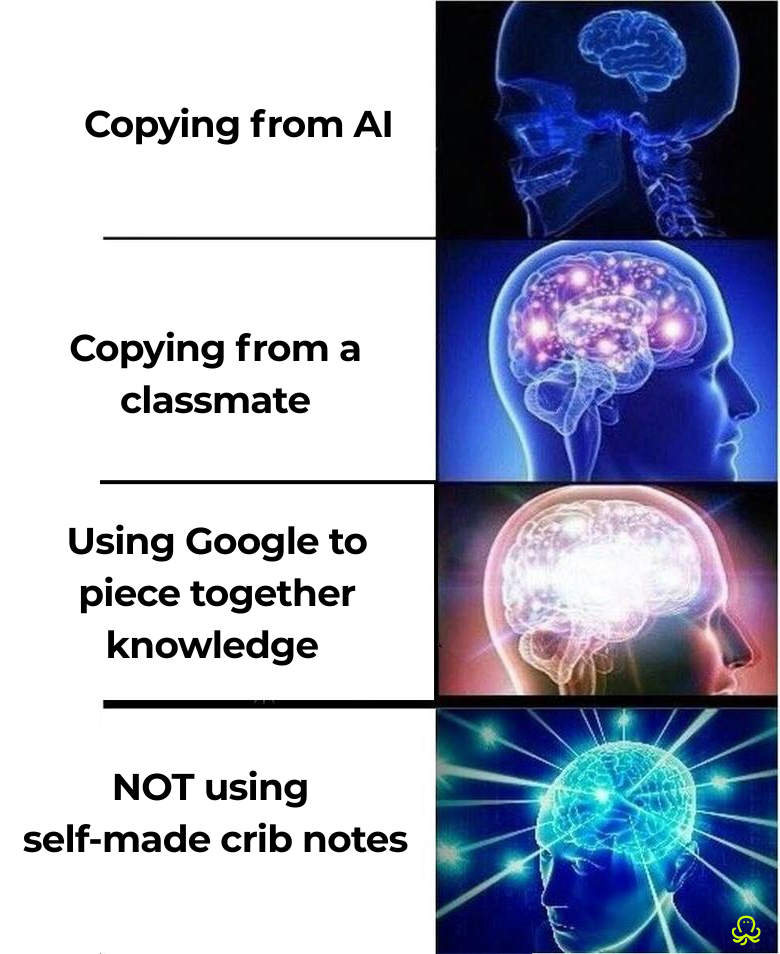
Here’s the strategy: take notes by hand during class. Then, during self-study, turn those notes into short-form journals. Finally, build your crib notes based on the study guide, simulating exam conditions by re-writing them again (and again) from memory. You’re layering learning through repetition, movement, and recall, while becoming psychologically accustomed to independence from notes or other forms of assistance.
And yes, obviously: no crib notes allowed during the actual exam (unless it's open-book – we’re not monsters 😉).
Encourage students to write by hand instead of typing on a computer. Introduce in-class exercises that require students to practice handwriting, such as brainstorming sessions.
Be open about the benefits of crib notes and actually teach students how to use them for exam studying. Reiterate that it is not an open call to use those during the actual assessment.
Everyone loves actions that support moral efforts. Fine-tuning proctoring to match your cohort’s features is a must and should not be rocket science, nor should it give a special advantage. I recommend the following easy tweaks:
Let test takers return to prior questions/sections. Reduces panic loops and helps memory recall. Guard with a simple warning if they try to exit a scored section early.
One of the worst features of the proctoring exam I have recently found was the 2025 California bar’s essay tab-hopping. Pin essay prompts beside or above the response box. Working around prompts from memory in exam circumstances is inhumane and creates chaos.
Use small, timed toasts for routine notices. Reserve modal pop-ups for true blockers. Proctors can “batch” messages instead of interrupting mid-sentence.
.png)
“Please, don’t bombard your test takers like that, have some decency.”
One or two 90-second candidate-initiated pauses per section for genuine issues (eye strain, sneeze attack). Auto-resume with a quick ID re-check.
I can’t stress the importance of the proctored mock exam enough. It is human to be afraid of the unknown. Stress levels decrease when students see the same buttons, the same timer, and the same proctor chat. A 10-minute rehearsal lowers day-of friction more than another study guide.
Academic dishonesty isn’t always a calculated act of rebellion. Sometimes, it is panic. Sometimes, it is brain fog. And more often than not, it is a reaction to pressure systems that fail to account for how memory, stress, and learning actually work.
I have often experienced how a blocked thought, a mistimed recall, or an anxious guess might appear to be cheating in the eyes of an educator. But these are cognitive frictions, and any adequate methodologist or educator should remember how they themselves struggled with those as students. I also do not understand educators who choose to act as stern gatekeepers instead of helping and paving the way for the future. What is the point of being the greatest when you are burned out, angsty, and alone in your field, without new generations that will continue your efforts? And are you truly the greatest if there is no competition? Gatekeeping is a dead end.
That’s why it’s time for us, as an industry, to move away from blind policing test-takers and toward understanding them. Yes, online proctoring prevents cheating, but it can also protect learners from unfair suspicion when paired with better design, healthier study habits, and more supportive communication from educators.
If a student’s brain malfunctions mid-exam, the solution lies in systems and environments that reduce cognitive strain and build clarity from day one.
So, here’s my final crib note:
Memory isn’t always a matter of effort or integrity. It’s a complex, very human system, and understanding how it works can help us build fairer, smarter assessments.
And that starts long before exam day.