One of the biggest challenges for online proctoring solutions isn't detecting events, it's interpreting them correctly.
A credibility score should help administrators understand whether an assessment can be trusted, not simply assign a number. That's why we've redesigned the way OctoProctor evaluates, visualizes, and reports proctoring results.
Previously, credibility scoring relied on session-wide averages. While effective in many scenarios, this approach could unintentionally favor longer assessments by diluting isolated violations over time.
OctoProctor now evaluates violations within discrete time intervals, ensuring that significant events carry appropriate weight regardless of how long the assessment lasts. The result is a fairer and more consistent credibility scoring for online exams, giving administrators greater confidence that similar behavior receives similar treatment across sessions.
Not every proctoring signal deserves the same importance. The updated scoring model allows administrators to assign different weights to different violation types. Highly reliable indicators can contribute more strongly to the final proctoring score, while metrics that are naturally more susceptible to environmental noise can have a lower impact.
This makes automated evaluation better aligned with institutional policies and different assessment scenarios.
Understanding why a session received its credibility score is just as important as the score itself.
Updated timelines, histograms, session cards, PDF reports, and proctoring session reports present detected violations in a clearer, more intuitive way. Administrators can review sessions faster, understand what influenced the final score, and make more informed assessment decisions with less manual interpretation.
Identity verification plays a critical role in maintaining assessment integrity, particularly for certification programs, admissions, and continuing education.
OctoProctor v5.11.0 introduces a redesigned identity verification workflow that improves automatic verification accuracy while making manual review more intuitive.
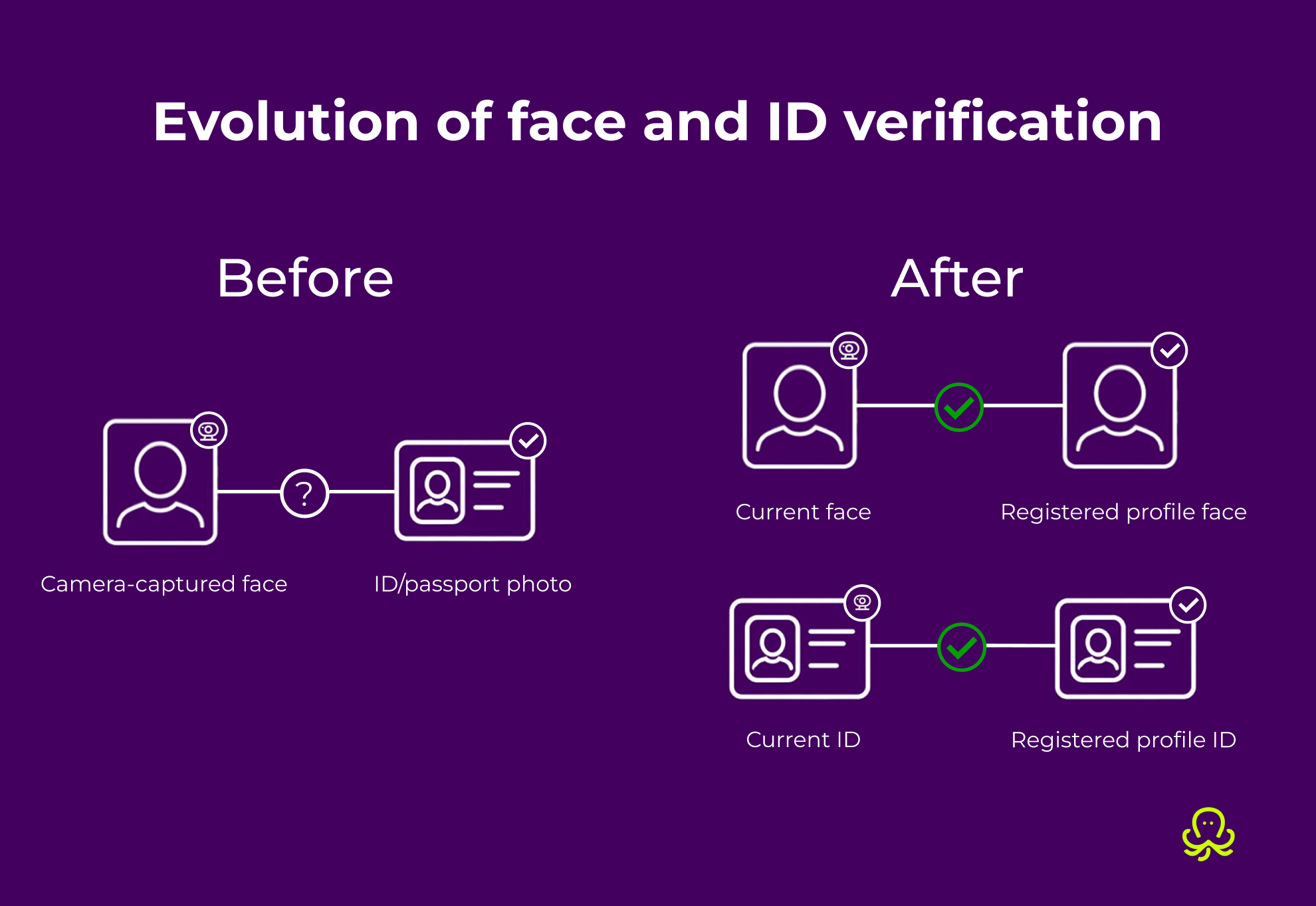
Face verification and passport verification are now evaluated independently instead of relying on a single comparison.
This improves the reliability of identity verification for online exams, particularly for organizations that require mandatory automated identity verification before allowing a learner to begin an assessment.
Identity verification doesn't stop after the first session. Once a learner successfully completes identity verification, OctoProctor securely stores trusted facial and document references. Future sessions are compared against these references, helping institutions ensure that the same individual participates throughout a certification program or ongoing training journey.
When additional review is required, administrators and proctors can now compare identity evidence side by side, review verification results, and identify potentially similar user profiles from a single interface.
This makes online assessment identity verification faster, more transparent, and easier to support during audits or appeals.
Educational organizations increasingly expect assessment platforms to integrate seamlessly with their learning management systems.
This release expands OctoProctor's support for the latest LTI Advantage services, strengthening LMS proctoring integration while preparing the platform for formal LTI Advantage certification.
OctoProctor now supports additional LTI Advantage services for grade synchronization, roster management, and instructor-driven content linking. These improvements enable more standardized integration workflows across LTI-compatible LMS platforms.
Expanded support for Deep Linking allows instructors to create and configure proctored activities directly from their LMS, reducing manual setup and minimizing reliance on LMS administrators.
Support for Assignment and Grade Services (AGS) and Names and Roles Provisioning Services (NRPS) lays the groundwork for increasingly automated LMS integrations as institutions continue adopting modern interoperability standards.
Small improvements often have the biggest impact on everyday work. This release introduces contextual add-on tooltips throughout the administrator interface together with refined terminology and improved localizations.
The result is a configuration experience that's easier to understand, quicker to learn, and less prone to mistakes — particularly for new administrators managing complex assessment workflows.
This proctoring software update also includes ongoing improvements to LMS integration reliability and compatibility.
These updates help ensure smoother assessment delivery across supported learning management systems, reducing integration-related interruptions and providing a more consistent experience for administrators, instructors, and test takers.
Every release moves OctoProctor toward the same goal: helping organizations deliver assessments they can trust.
With fairer credibility scoring, stronger identity verification, expanded LMS interoperability, and continuous platform improvements, this proctoring software update helps institutions make assessment decisions with greater confidence while simplifying the day-to-day work of delivering secure online exams.
Whether you're running certification programs, admissions testing, workforce assessments, or compliance training, these improvements make online proctoring more transparent, more reliable, and easier to manage.
Book a personalized walkthrough to explore the latest credibility scoring improvements, identity verification workflow, and LMS integration enhancements with our team.
Book a demoOctoProctor v5.11.0 introduces a redesigned credibility scoring model, enhanced identity verification for online exams, expanded LTI Advantage support, improved LMS proctoring integration, and several usability and reliability improvements. Together, these updates help organizations make more informed assessment decisions while simplifying day-to-day administration.
The updated credibility scoring model evaluates violations more consistently regardless of session length and allows institutions to assign different weights to different violation types. This results in a fairer proctoring score, clearer proctoring reports, and greater confidence when reviewing assessment outcomes.
This release introduces a redesigned identity verification workflow that evaluates facial and document verification separately, improving automatic verification accuracy. Trusted identity references are securely reused in future sessions, making identity verification for online assessments more reliable while also simplifying manual review when needed.
Instead of verifying learners independently for every assessment, OctoProctor maintains trusted identity references that can be compared during future sessions. This helps certification bodies, universities, and training providers confirm that the same individual participates throughout an entire learning or certification journey.
OctoProctor now supports additional LTI Advantage services, including Assignment and Grade Services (AGS), Names and Roles Provisioning Services (NRPS), and enhanced Deep Linking workflows. These improvements strengthen LMS proctoring integration, reduce manual configuration, and make it easier to deploy proctored assessments across LTI-compatible learning management systems.
Yes. Administrators can configure the weighting of different violation types to better reflect their institutional policies and assessment requirements. This flexibility allows the credibility scoring system to adapt to various exam formats while keeping proctoring reports transparent and easy to interpret.


OctoProctor v5.10.0 brings lockdown browser-level protection into default browsers, introduces lightweight presence verification workflows, and allows for proctoring setup directly from LTI-compatible LMS platforms.