A Holly Grail question for test takers and a pet peeve for educators who may be too tired even for an eye-roll for another student failing exam for cheating, this has been our most popular article for a reason. It mostly attracted test takers, but it’s about time to flip the script.
Educators, have you ever thought of the different ways one can cheat on exams, especially while composing one? I always wonder about the relationship between educators and proctoring. Some intentionally create an integrity strategy around the tool's benefits, while others see it as their institution's compliance layer separate from the exam.
I, of course, wish more educators were aware of how to cheat in online exam before administering them. While yes, choosing a tool seldom depends on the faculty member, proctoring literacy helps create an experience that is both truthful and respectful to test takers.
Whenever I stumble on another hysterical LinkedIn post about how the next generation will drive this world to shambles because of online learning and lack of academic honesty, I feel petrified. Academic cheating has always been a major problem in education. Yet, McCabe’s outdated “95% of students admit to cheating,” used out of its high school context in research and blogs alike, seems to have become an edunet creepypasta.
For goodness’s sake, keju cheating in ancient China is 1400-year old practice. And, as I said before, it is safe to assume that most of us have cheated in one way or another. I myself did not know of all the terms for academic cheating before getting a job at OctoProctor. And what happens when students don’t know something or are unaware of something?
If something is not explicitly penalized, we live in a free world. That’s why you write not to ingest alkaline batteries, yet there will still be trends like eating Tide pods. People will do what they are not supposed to, and as an educator, you need to be explicit with test takers about what they should not be doing. Colleges and universities cannot outsource integrity culture to software alone.
What is true, however, is that educational institutions and test centers have to constantly adapt to the ever-changing reality of studying, including new methods of cheating. In this post, I will review 10 popular methods of cheating during online proctored tests, plus some useful ideas for minimizing academic misconduct in the digital environment.
A proctored exam means that test takers are being watched by an official (aka proctor, aka invigilator) the whole time they are taking the assessment. Students prove their identity by enabling their web cameras and providing a photo or ID scan before the assessment. After identity verification and equipment checks, students can take the test. Proctoring software will indicate questionable conduct and, depending on the application, inform the human proctor or report it for further review.
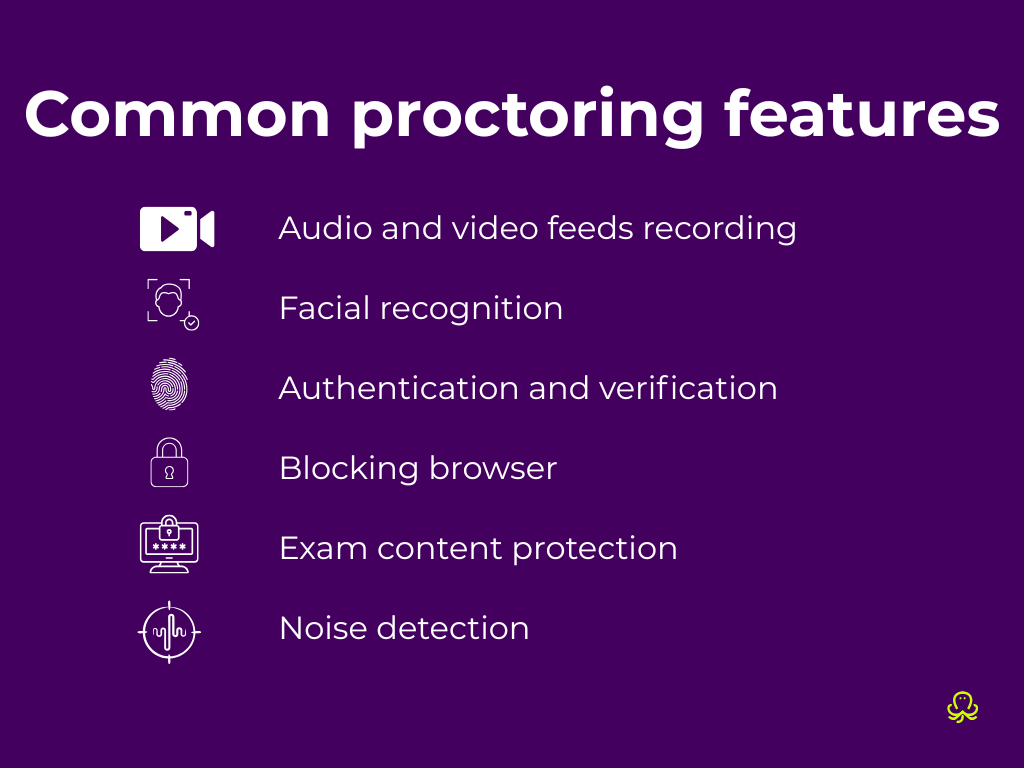
Some proctoring software is more configurable, while others are sold as majorly set systems and it makes a large difference in day-to-day operations. For example, OctoProctor helps institutions adapt proctoring to the specific risk level, format, and support needs of each assessment. Educators can configure monitoring metrics and reporting parameters while adding features such as identity verification, content protection, mobile camera monitoring, lockdown-level browser protections, live chat, virtual machine detection, and more.
Tech has helped both students and academic institutions realize the flexibility, scalability, and cost-effectiveness of online education. With every spark comes another. Increased access to information leads to different uses. Including cognitive offloading, the first wave of which happened in the naughties.
And, apparently, we are doing more than ok, more than 30 years after WebCrawler. Not convinced? Ask my mom if she misses Big Soviet Encyclopedia at home… or rather a big ol dust collector.
My biggest issue with exams as a PhD student and young professional is that most people who write exams haven’t sat one in a long while.
I truly believe that being in a higher position without an honest feedback loop and empirical learning boosts one's ego too much. If you feel uncomfortable with me mentioning taking an exam, maybe it is indeed time.
I dare you to cheat on your own exam, just to get the full understanding of what works and what doesn’t. Try breaking every online test rule possible, and have fun with it. What this experience will prove is how hard it is to actually cheat on a proctored exam, especially for university students. It will help you understand that most of your students will likely never succeed. What’s even more interesting is that students are far from naive, and most know better not to cheat on a proctored exam.
And if someone still decides to test the cheating waters, that’s fully on them, and yes, you have every right to report them for investigation. You should, because it makes a difference for everyone. Lukewarm integrity is probably worse than the cheating itself.
If academic stress is high and expectations are vague, even honest students may become more tempted to “optimize” their way through a bad exam.
A useful integrity strategy starts before the exam: clear rules, fair assessment design, accessibility-aware procedures, and a proctoring setup that actually matches the risk level of the assessment. The point of exam pentesting is to know what can go wrong, explain expectations to test takers and vendor clearly, and configure the right safeguards before the exam goes live. Cheating is rather a creative process and I would say the space is the limit (for now) – take a look at the cheat sheet :)

Ready to dive beyond the iceberg tip? Below are ten common risk patterns in online proctored exams, how they usually appear, and how educators can test whether their current proctoring setup is doing what they think it does. And yes, your chance to be the next James Bond!
Still one of the most common types of misconduct. Impersonation happens when someone other than the registered test-taker completes part or all of the exam. In online exams, this can happen at the beginning of the session during identity verification, or later if the original test-taker hands off the account, shares login details, or tries to replace the camera feed.
The risk has also changed since the early years of remote exams. The world now has dynamically developing AI deepfakes that are already democratized. If you are using a weaker solution, you may soon see AI deepfake cheating rise.
Basic ID checks are no longer enough for every assessment because identity substitution can involve remote desktop tools, virtual camera streams, pre-recorded video, or AI-generated face manipulation. This does not mean every online exam needs maximum security, we have voiced against it on numerous occasions. It does mean that high-stakes exams should not rely on one static identity check before the timer starts.
To reduce this risk, institutions can use ID verification, face matching, continuous face presence checks, virtual camera blocking, session recording, and review workflows that make mid-exam identity changes visible. For higher-risk assessments, multi-factor authentication may also help: verified ID, webcam-to-document comparison, one-time passwords, or other institution-approved identity checks.
Run a mock exam using a test account. Check whether the system blocks virtual cameras, flags a missing or changed face, captures the relevant timestamps, and gives reviewers enough evidence to understand what happened. If identity is verified once and then forgotten for the rest of the exam, that is a gap worth discussing with your vendor.
Back in the day, a test-taker shared their screen with someone on Zoom or Google Meet and received real-time help. That still happens, but “screen-sharing” is now too narrow as a category. The broader risk is unauthorized collaboration during the exam.
A helper may be in the same room, on a call, in a chat, watching the screen through a remote tool, or receiving screenshots of exam content. The test-taker may not even need full screen-sharing if they can expose enough information. Contract cheating is the more organized (crime) version of outside help. Someone else is paid or otherwise recruited to complete academic work or assessment tasks which often concludes with extortion.
To reduce this risk, educators should look for screen recording, active window and tab monitoring, unauthorized application detection, messaging and meeting-app restrictions, remote desktop detection, live chat escalation, and detailed reports. For high-risk exams, a mobile camera can also give reviewers a better view of the workspace and the test-taker’s off-screen behavior.
Ask someone to team up and try out passing response from under the table, for example. You may think it is silly, but if room scan is unavailable in your organization for some reason, it indeed happens that way.
Alternatively, in a mock exam, try to open a meeting app, switch to a messaging tool, launch a remote desktop session, or move between the exam and unauthorized windows. Your aim is to see shenanigans both blocked and included in the report for further review.
Second devices are one of the most current risks in remote exams. Even if the testing device is locked down, a test-taker may try to use a phone, tablet, smartwatch, smart glasses, second laptop, earbuds, or another connected device outside the monitored screen.
.png)
This is why same-device browser restrictions are useful but incomplete. A lockdown browser may stop a student from opening another tab on the exam laptop, but it cannot automatically solve the problem of a phone under the desk. That requires a combination of policy, camera visibility, room scans, object detection, audio monitoring, human review, and reasonable exam design.
To reduce this risk, institutions should explain device rules before the exam, require test-takers to remove unauthorized devices from the workspace, and configure monitoring around the risk level of the assessment. Mobile camera monitoring can also help when the main webcam does not capture the desk, hands, or surrounding area well enough.
During a mock exam, place a phone, smartwatch, or tablet in several realistic positions: visible on the desk, partly visible, just outside the webcam frame, or used briefly off-screen. Then check what the recording, flags, and report show. A good setup should not rely on a single perfect camera angle only.
Searching for answers online used to mean opening Google or browsing course materials during the exam, hoping for luck. The 2026 category is broader and serves a larger pool of users: search engines, homework-help sites, AI chatbots, browser extensions, image search, copied question text and screenshots.
And, AI is both getting more routine and normal-looking. People adapt AI writing traits because AI-created copywriting is so widespread as part of AI homogenization. Those relying on detecting cheating based on built-in radar, called “lived experience,” may find themselves progressively catching less AI.
Before this discussion takes a turn for a witch hunt, not everything AI is cheating. That depends on the assessment policy. For example, Austrian universities are more open towards AI usage given that there is disclosure. But if an exam is meant to measure unaided performance, educators need to be explicit about whether GenAI tools, browser extensions, paraphrasers, calculators, translation tools, or external websites are allowed.
To reduce cheating during closed-book exams and unauthorized help during open-book tests, institutions can use lockdown-level browser protections, copy-paste restrictions where appropriate, blocked tabs and applications, screen recording, browser activity monitoring, and incident-based review.
Mind it that the assessment design matters more than the way you protect the exams. Questions that rely only on searchable facts are easier to outsource than localized questions requiring applied reasoning, oral defense, unique datasets, or process-based work.
In a mock exam, try to copy question text, right-click, switch away from the exam page, use a browser extension, or open an unauthorized site. Then check whether the behavior is blocked, flagged, or simply invisible. For AI-specific risks, test both same-device and second-device scenarios – students can use their mobile phones, smartwatches, and other devices to look for information or store data.
It’s recommended to adopt proctoring software that ensures:
Back in the day, virtual machines were a big problem. And VMs are still a relevant risk, but mature exam security tools are now much more aware of them.
A virtual machine, emulator, or remote environment may be used to separate what the proctoring system sees from what is actually happening on the device. In weaker setups, the exam may appear to run in a controlled environment while the test-taker uses another layer, device, or remote session outside the monitored space.
Some, however, use VMs because they are concerned the software will have access to private documents due to downloading something onto their PC. Some use VMs because it is mandated by their organization. To reduce this confusion and friction, choose browser-based proctoring solutions.
And to curb virtual machine-related cheating, institutions can use VM detection, remote desktop detection, secure browser settings, operating system checks, and pre-exam diagnostics. To be more caring about all VM users, the rules should be clear, and support channels should be available before the exam starts.
Ask your vendor or IT team to run a controlled compatibility test with virtualized and remote environments. The goal is to confirm whether the system blocks, permits, or flags these environments under your chosen exam settings.
Before I raise too many eyebrows here, the risk is not only a projector but any external display or mirroring setup that lets someone else view exam content. Think about a second monitor, HDMI output, USB-C display, wireless casting, TV, projector, or screen duplication. That’s a lot of stuff, and people do not take exams in a vacuum.
Without a thorough room scan, a test-taker may keep their main exam device locked down while sending the same content to another display. A helper does not need to control the exam if they can see the questions and signal answers through another channel.
To reduce this risk, institutions can use display detection, restrictions on multiple monitors, secure browser settings, room scans, second-angle mobile camera monitoring, and clear rules about screens, mirrors, glass partitions, and shared spaces.
In a mock exam, connect a second monitor or attempt screen mirroring under controlled conditions. Check whether the system blocks the setup, requires disconnection, flags the event, or allows it silently.
Old-school cheating did not disappear because some exams moved online. I have said it on numerous occasions, but cheat sheets are much more effective. First, it’s fully controlled and a question of the virtuoso level you deal with. Second, test takers learn because to be successful with written notes, they need to understand and synthesize the material.
And for goodness's sake, if one does not understand math, they will not solve anything even if you put a large formula banner in front of them.
Proctoring can reduce sneaky note-cheating, but no single webcam view sees everything. The better approach is to combine clear exam rules, room and desk scans, camera positioning, audio/video monitoring, mobile camera where appropriate, and human review of suspicious moments. And let me reiterate: educators should also define which materials are allowed, what must be removed, and what happens if unauthorized materials appear during the session.
Place permitted and non-permitted materials in different parts of the workspace during a mock exam. Check what is visible from the main webcam, what appears in the mobile camera view if used, and how easy it is for a reviewer to confirm whether a rule was actually broken.
Oh, we have reached my pet peeve. Repeat after me:
– Bathroom breaks are not cheating.
– Internet issues are not cheating.
– Accessibility needs are not cheating.
Breaks and interruptions can create integrity gaps if the policy is unclear or if the room is not re-checked afterward. That’s it.
A test-taker may leave the camera view, speak to someone, access notes, use a device, or return to a changed workspace. You know what else can happen during a break? Another royal wedding, the end of the world or a cat may give birth to kittens. Obsessing over what ifs is counterproductive.
A strict “no breaks, ever” policy is unreasonable, inaccessible, or simply inappropriate for longer assessments. International students may be dealing with different exam cultures, language expectations, time zones, and documentation rules, so “common sense” policies should still be written down. Clear and transparent rules will save you a lot of trouble.
To reduce this risk, institutions should decide in advance whether breaks are allowed, whether they are scheduled or unscheduled, and whether a room scan is required after returning. Accommodation procedures should be separate, respectful, and documented.
Run a mock exam with a permitted break and an unplanned interruption. Check whether the system:
Content leakage can happen when test-takers take screenshots, record the screen, photograph questions with a phone, copy-paste prompts, share items in social media group chats, or save exam content for future cohorts.
Some great minds are known to take exams only to memorize them and pass on to the next time zone. This risk matters beyond a single exam session because leaked questions can compromise an entire item bank, and major exams like the SAT have annulled entire regional results on numerous occasions.
To reduce this risk, institutions can use content protection, screenshot and screen recording restrictions, copy-paste controls, watermarking where available, randomized question pools, time windows, browser protections, post-exam review, and screen recording.
Mind that in enough cases it is not students who leak, but proctors and hosting institutions. And more often than not, it happens with pen-and-papers.
So, maybe removing a few humans from the framework will actually help your organization with exam leaks more than only chasing test takers. Assessment design helps too: large item banks, question variants, applied prompts, and adaptive exam approach reduce the damage of any single leaked item.
In a mock exam, try to copy text, print, screenshot, record the screen, or photograph the screen with a second device. Check what is blocked technically, what is only flagged, and what appears in the report. Same-device controls and second-device leakage should be tested separately.
Not exactly “cheating,” but I would not be me without this honorable mention because we will never get tired of talking about it at OctoProctor.
Weak platform configuration or poor assessment security cannot be solved by anyone but you. For example, risks may arise from exposed answer keys, proctoring client-side answer logic, weak access controls, misconfigured LMS permissions, visible metadata, predictable question order, or poorly protected APIs.
All of that exposes nooks and crannies that people may leak into without really trying.
Look for anything odd. Click around, and you will find out ;)
Cheating in online proctored exams does not need a funeral organ soundtrack to be taken seriously. It blurs the line between the student’s own academic work and someone else’s contribution. Therefore, it is not ideal, it is not harmless, and it is also not proof that an entire generation has lost its moral compass. Most test-takers want to finish the exam, close the laptop, and get their aftercare. Still, when cheating happens, institutions need to understand why it matters and what can be done about it.
First, cheating makes assessment results less trustworthy. If an exam is supposed to show whether a student can solve clinical cases, apply legal reasoning, write secure code, or understand core course material, outside help changes what the score actually means. The institution may no longer know what the test result is measuring.
Second, cheating is unfair to students who did the work. A student who studied honestly should not be competing with someone’s cousin on WhatsApp, 4 largest AIs hidden on a phone under the desk, or a suspiciously productive second monitor. Academic integrity should be about protecting the value of honest effort. Catching misconduct for its own sake will not build a culture of integrity.
Third, cheating creates an administrative mess. Weak exam rules, vague evidence, and inconsistent review workflows can turn one suspicious session into a week of emails, appeals, screenshots, and “but my internet was bad” explanations. Clear policies, transparent proctoring settings, session recordings, timestamps, and audit-ready reports help institutions separate genuine technical issues from misconduct without relying on “your word against mine.”
Fourth, repeated cheating can damage program's credibility. While I do not believe that AI will breed a secret rank of doctors who cheat their way into the operating room, I still want my localizer to be local and certified.

That said, integrity is not only the student’s responsibility. Leadership sets the tone, and students always notice. Proctoring can help protect an exam, but it cannot fix a broken learning environment on its own.
Do not treat every webcam blink like a crime scene. Build an assessment process in which honest work is respected and protected, questionable behavior is subject to review, and everyone understands the rules before the exam begins.
And remember, there is nothing that solves 100% of academic dishonesty. We do not live in a sterile dystopian lab. I wouldn’t want to.
You cannot stop every possible attempt to cheat, but you can make cheating harder, riskier, and less attractive.
Modern education can feel like an arms race. Students optimize, institutions optimize back, vendors optimize the optimization, and somewhere in the middle, a perfectly normal exam becomes a miniature border checkpoint. That is not the future anyone should be excited about.
AI has made this tension more visible, but it did not invent the problem. Every major technological shift teaches people how to work faster, outsource effort, and cut corners. The Industrial Revolution had Taylorism; modern learning has AI, automation, answer-sharing, browser extensions, and a thousand tiny shortcuts that promise to save time. Some of that optimization is useful. Some of it is just mediocrity with better packaging.
There will always be a cheaper way to produce average work. The more important question is whether education still knows how to recognize and reward academic brilliance in the long term. If excellence is measured only through once-a-year memory contest under pressure, then students will keep looking for ways around the system. People respond to incentives.
As tech moves toward interoperability, I can see the future of online proctoring becoming more configurable, more hybrid, and more focused on proportionality. Some exams will need strict lockdown-level protections, identity checks, mobile camera monitoring, and detailed review. Others will need lighter participation monitoring or no proctoring at all. The smarter and more humane approach is to choose the right level of assurance for the actual risk.
So, yeah, cheating does matter. It discourages honest effort, erodes assessment data, and causes administrative confusion that no one has time for. Fear, moral theater, or another layer of bureaucracy are never the solution. The solution is to have a more open discourse among educators, test takers, leadership, and technology teams about what the exam is supposed to prove, what risks are realistic, and how to maintain integrity without turning learning into a compliance obstacle course.
There are vendor-specific walk-arounds and general cheating strategies. We would love to hear about your case and find a solution together.
Talk to us!Academic cheating is a form of dishonest behavior that provides students with an unfair advantage. It can appear in various forms such as plagiarism, falsification of documents, impersonation, etc. Academic infidelity, including online exam cheating, is a serious problem that poses a threat to the entire goal of education.
Many online proctoring solutions help educational institutions protect the integrity of online exams.
An online test can be proctored live, monitored automatically, reviewed after the session, or protected with a lighter configuration. Proctoring solutions come with a wide range of customizable features such as audio/video proctoring, content protection, face recognition, etc.
AI-based proctoring software can detect extra devices such as phones, tablets, smartwatches, etc. It monitors the examination process in real time and flags any suspicious noises and activities in the testing area. You could also understand if something is wrong based on the recorded student behavior during the remote proctored exam.
Video proctoring is among the most common features used to prevent cheating on online exams. Depending on the type of remote proctoring solution, students can be monitored either by a live human proctor or AI-based software that can flag any suspicious student activities.
A blocking browser uses the device’s web camera and microphone to monitor the examination process and spot any undesirable activities. This type of proctoring usually restricts a great number of on-screen activities and prevents students from surfing the internet.
AI proctoring is based on machine learning. It detects and flags events that may require attention, such as unusual eye movement, the absence of a face in the frame, background noise, additional people, or suspicious device activity. It does not necessarily mean the exam is fully automated: AI can support live proctors in a hybrid proctoring approach, reducing manual checking after the assessment.
Look into auto proctoring, but always check vendor’s description for the solution. In OctoProctor’s case, no AI is involved in auto proctoring. Auto proctoring means the exam is monitored without a live proctor watching the session in real time. The system verifies the test-taker’s identity, runs the required equipment and environment checks, records the session, flags possible incidents, and generates a report for later review by the institution.
There are several ways test-takers may try to cheat on a proctored online exam: impersonation, outside help, second devices, screen-sharing, virtual machines, unauthorized browser activity, hidden notes, or sharing exam content with future cohorts.
The point of understanding these methods is not to help students cheat, but to help educators close predictable gaps before the exam starts. A good integrity setup combines clear rules, fair assessment design, identity verification, configurable monitoring, lockdown-level browser protections, incident reports, and review workflows that distinguish real misconduct from technical noise.
A student failing exam for cheating is an offense, whatever the reasons may be. The exact consequences of cheating vary by institution, program, country, and, in the United States, sometimes even by state or accreditor.
The institution should follow its academic integrity policy rather than make a rushed decision based on a single suspicious signal. Proctoring evidence, such as session recordings, timestamps, identity checks, screen activity, and incident reports, should be reviewed in context.
Students also need a clear appeal or explanation process, especially when technical issues, accessibility needs, or ambiguous behavior may be involved. The goal is not to punish first and investigate later, but to protect honest test-takers while keeping the review process fair and documented.
You should look for proctoring providers that offer detailed, audit-ready reports, as they save admins a lot of time when test takers challenge the outcome. This is also one of the biggest pros of remote proctoring, in my opinion. When you have a large 200-person class take an exam simultaneously face-to-face, you can’t really track everything and will have a cumbersome experience during integrity investigations.
The closest type of invigilation to an in-person one is live proctoring, quite common variant of an academic exam. Organizations use either in-house proctors or outsource them to monitor exams remotely. They act according to the pre-defined rules and are often helpful when test-takers need immediate support.


Is everyone cheating in college because of AI? Or is AI simply exposing deeper problems in how we design exams and measure learning? A reflection on AI in higher education, cheating with AI, and why nostalgia may not fix the system.