Cheating is uncomfortable to admit, partly because it is so recognizably human. And notably, all three OctoProctor experts – Anton, Marina, and your one and only admitted to cheating at different points of their lives (can we have a round of applause for that honesty?).
It is fascinating how science exoticizes cheating performed by corvids or apes as a sign of higher intelligence. We stimulate dishonest behavior on purpose in animal research when we, humans, are taught otherwise 🧐
For some test takers, cheating is a last resort. For some, it is part of the student experience; for others, cheating is an addiction. What unites all cases is that test takers put a great deal of effort into finding ways to improve their results
In this article, I am not going to preach against cheating or demonize a select group. I will walk you through the statistics and explain the reasons for and forms of academic misconduct. Deal?
This article will use the word cheating a lot, and if you were brought here searching for “cheaters caught on video,” I am not sorry! 🤭 They are connected, though – the mechanics and reward biology are pretty similar.
Academic dishonesty definition refers to committing some unethical act related to studying, teaching, or research, intending to achieve better results. Some common types of academic misconduct that you encountered include:
This is the broad umbrella: using help, materials, devices, or workarounds that were not allowed for that task in the first place. That can mean hidden notes, unauthorized websites, using a second device off camera, or getting “just a little help” from tools or people when the rules said no. In 2026, this also includes undisclosed AI assistance when the assessment is meant to reflect your own knowledge.
M-m-m, presenting someone else’s words, ideas, structure, design, code, or analysis as your own without proper credit, a classic.
To be fair, no idea is new, and I have been terrorized by some plagiarism checkers for non-specific parts of sentences matching someone’s coursework that was not even published online. Some departments actually push students to give random credit with "n% plagiarism" ballparks.
Maybe, just maybe, we should let students breathe.
Collusion is unauthorized collaboration dressed up as “we just worked on it together.” Think of parents lovingly doing their kids' homework. Contract cheating is the more explicit version: getting somebody else to produce the work for you, whether that somebody is a friend, a freelancer, an essay mill, or, increasingly, an AI system used beyond what the assignment allows.
Some learners fall victim to the promises of proxy test taking and then get blackmailed by the cheating vendor.
Fabrication is when the evidence itself is made up. That can mean inventing data, sources, quotes, lab results, fieldwork, citations, references, or observations that were never actually found or accepting a polished hallucination because it looks academic enough.
AI solved plagiarism! 20% down and the momentum will likely to persist.
Before AI, plagiarism was the most common form of academic misconduct. It made up about two-thirds of all academic misconduct, according to The Guardian. Now, AI misuse is rising, institutions are still learning how to track it, and, spoiler, detectors are pretty bad at it. On many occasions, university AI policies are just wishful thinking.
Scary-looking statistics and trends do not mean every student is cheating all the time. They do not represent every living test taker, and your cohort can be very different. What statistics should mean to you is that the integrity problem has changed shape, and higher education is still catching up.
Sorry to disappoint you, but we’ll know about 2026 when it's 2027. That’s how large-scale, serious studies work – taking time. What we can do is conclude the changes that were measures over 2025, though.
US: Inside Higher Ed reported that 85% of US students said they had used generative AI for coursework, 55% used it for brainstorming, 50% used it as a tutor-like tool, and 46% used it to study for quizzes or exams.
UK: Josh Freeman’s HEPI Student Generative AI Survey 2025 found that 92% of UK undergraduates had used AI in some form, 88% had used generative AI to help with assessments, and 18% said they had included AI-generated text directly in submitted work. 80% said their institution had a clear AI policy, yet only 36% said they had received support to develop AI skills.
Jordan: Alnsour et al. reported that 78.1% of Jordanian university students used AI in academic activities, with about half using it frequently.
Vietnam: Tran et al. found that 46.4% of students considered GenAI use to be cheating, while 26.3% of participants said they might use the tool for plagiarism in the future.
Italy: 38.7% had openly used GenAI for academic tasks in Farinosi et al.'s survey of 1,366 university students across 24 Italian universities. Based on indirect responses, as much as 48.8% used artificial intelligence.
Short response: no, elite colleges and universities are not immune to cheating. While many go there to pursue knowledge, a substantial number attend top 1% universities for the hype or legacy. Because of the competitive nature of such universities, every exam feels high-stakes, and students resort to cheating despite honor codes or stricter professors.
University of Toronto (Canada), 2025: Academic misconduct continued to fall from pandemic highs, reaching 1,790 student offenders in 2024–25, down from 2,068 in 2023–24 and 3,668 in 2020–21. That put the 2024–25 rate at 1.8% of the student population.
UNSW (Australia), 2024: Reported 2,154 plagiarism and academic misconduct cases, up 42% from 2023. Among substantiated cases, it recorded 132 serious contract cheating cases, 118 unauthorized communication in exam cases, and 49 unauthorized materials or property in exam cases.
UC San Diego (US), 2024: Logged 1,381 academic integrity reports in 2023–24, including 217 serious exam misconduct cases and 19 contract cheating cases.
U Penn (US), 2024: Among 332 reported academic integrity cases, there were 80 cheating cases, 71 unfair advantage over fellow students, 46 facilitating academic dishonesty, 40 unauthorized collaboration/use of another person’s work, and 28 misconduct during an exam.
Columbia University (US), 2025: Resolved 227 academic integrity cases. Its top academic-integrity charges were cheating (135 cases), unauthorized use of AI tools (79), violation of test conditions (42), unauthorized collaboration (37), and plagiarism (31).
Harvard College (US), 2025: Reported 138 cases reviewed in 2024–25. Of those, 100 cases (72.5%) ended with a responsible finding. Harvard also logged 141 reported concerns, with plagiarism (56) and exam cheating (32) as the most common categories.
King’s College London (UK), 2024: Reported 320 cases of academic misconduct, up from 212 the year before. Of those, 239 involved plagiarism/collusion, 22 contract cheating, and 59 other examination offenses.
In the HEPI 2025 survey, the most common uses were explaining concepts (58%), summarising articles (48%), suggesting research ideas (41%), and structuring thoughts (39%), although a meaningful minority of 18% also reported using AI-generated and AI-edited text in their assessments. The line between support and substitution is now contested in a practice that resembles the Wild West.
A 2025 mixed-methods study by Huang, Hash, Cummings, and Prena found that students recognized overt cheating with GenAI, but held mixed views on subtler forms of dishonesty. In descriptive-norms scenarios, around 70% of students indicated they would be likely to cheat with GenAI if peers were also doing so. Peers influenced cheating by 39.1%, professors by 34.8%, students’ personal motivations and moral beliefs by 17.4%, and institutions by 8.7%.
The mass cheating may soon also halt: Emmy Martin’s article discusses how AI becomes uncool among students, especially those in humanities.
A study by Adzima found no evidence that students self-reported significantly more cheating online than in face-to-face environments, even though some online behaviors were viewed as more serious. The same 2025 study also found that AI use for homework was seen as more acceptable than many other forms of cheating, which again points to blurred norms rather than a simple online-bad in-person-good split.
That said, assessment mode still matters. Hill and LoPalo’s 2024 study of 1,894 student-test observations found that students performed 9.1 to 9.8 percentage points better on online midterms, with the online premium especially large among lower-performing students. At the 10th percentile, the online advantage reached 14.3 percentage points, while the premium shrank sharply when instructors used never-before-seen questions.
In plain English: when questions are reusable and easy to outsource, online delivery can create more room for score inflation. When assessment design gets smarter (like adaptive testing), some of that advantage shrinks.
Institutions want clean detection, but the research keeps saying the problem is a mess. A 2024 University of Reading study found that 94% of fully AI-written submissions went undetected when inserted into a live university assessment system. On average, those submissions also scored half a grade boundary higher than real student work.
In a 2024 Waked et al study of 90 handwritten final exams by EFL university students, all six tested AI detectors produced false positives on authentic student writing, and the highest-scoring scripts were significantly more likely to be flagged than both median-scoring (mean difference 0.045, p=0.035) and low-scoring scripts (0.057, p=0.006).
As someone who has spent 10 years in higher education and works in EdTech, I can say there is no fair AI detector.
You can Google, they will try to sell you something like Grammarly with a claim of 99% accurate detection. Coincidentally, I have also used that tool for 10 years, and it flags my 2016 coursework as AI. I checked other popular AI detectors with more advanced essays from 2018-2021 that passed Turnitin, and guess what? Same hallucinated percentage sh*t🤡 Unfortunately, the same lesser evil sabotage is reported by Dadland Maye: students resort to “study” and outdo AI after unfounded allegations.
You read that right – AI detectors push students to use AI.
So yes, institutions are right to worry about AI-enabled cheating. But the answer cannot be “trust the detector and move on.” Right now, both under-detection and over-accusation are live risks.
The literature shifts from “ban harder” to” redesign better,” and the notion of a broader transition from theory to practice makes me hopeful.
Australia’s TEQSA guidance in 2024 argued for shifting the focus from detecting cheating to detecting whether learning has occurred. That is a big conceptual move, and frankly, a healthy one. Likewise, Freeman in the HEPI 2025 report recommends that institutions continually review assessments, stress-test them against current AI tools, teach students how to use AI responsibly, and keep policies under constant review as capabilities change.
The good news is that global policy is pushing for AI literacy among students and educators, as noted in our Q2 2026 EdTech trends article. Under Article 4 of the EU AI Act, providers and deployers of AI systems must take measures to ensure a sufficient level of AI literacy among staff and others using those systems on their behalf. If institutions use AI systems, they are expected to consider staff capability, context, risk, and training rather than pretending that a policy PDF (or honor code) solves the problem.
The US is taking a different route. Instead of a concrete AI literacy obligation comparable to the EU AI Act, the federal push has come through guidance and funding signals. In 2024, the U.S. Department of Education released a toolkit for safe, ethical, and equitable AI integration, built around federal law, privacy, civil rights, and digital equity. In 2025, the Department followed up with guidance stating that federal education grant funds may be used for responsible AI adoption when institutions remain in compliance with existing statutory and regulatory rules.
Not every cheating problem is a proctoring problem. For coursework essay submissions, OctoProctor or any other proctoring solution is not the one to fight AI or plagiarism. Live proctoring every low-stakes quiz also will not ensure learning sticks – one could still cram something, and their brains will erase it the moment the assessment is over. But some forms of academic misconduct are very much exam-security problems:
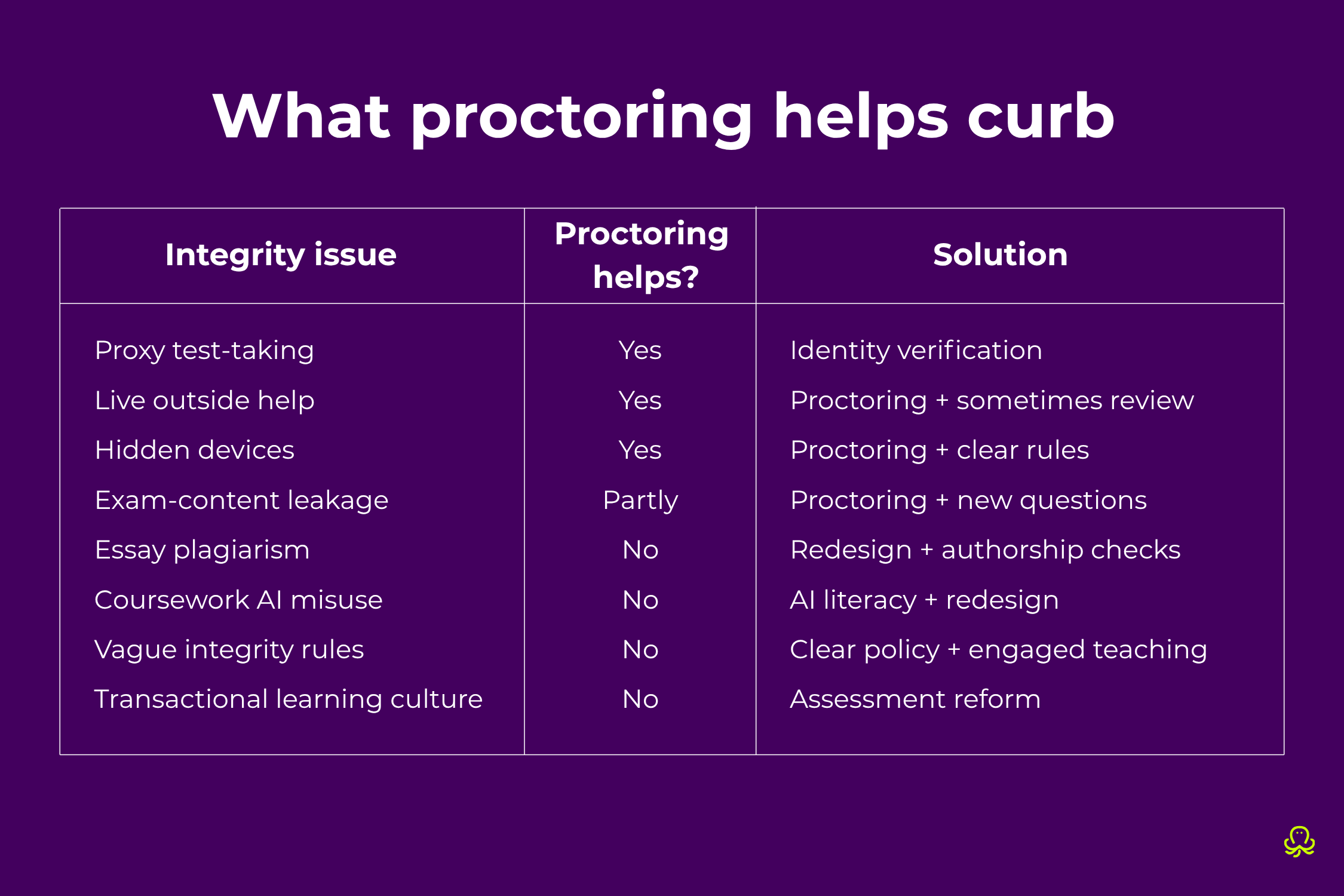
Of course, online exams are not limited to the ways discussed above. We must give props to creativity that appears the moment an assessment is high-stakes and remotely delivered where it’s due. As OctoProctor’s board member, Marina Detinko put it:
“But the presence of AI and cheating doesn’t automatically mean the system has suddenly collapsed. It means the tools available in the arms race have changed, which brings us to a more interesting question. The real issue was never whether cheating exists (it always has), the real question is whether the way we design assessments has evolved along with the tools people now use to learn and work.”
That is where proctoring is worth considering as a practical layer. Beyond blocking unauthorized apps via SEB features or catching Copygons and Proxyons, it can reveal exactly where your class is struggling. If you dare to look beyond raw flag numbers and contextualize them, you’d know whether there is an instruction failure, whether your exam could be designed better, whether there is a UI problem, whether the proctoring platform is misconfigured for your class, or whether proctors require more staffing or a training refresher.
And while yes, there may be false flags, proctoring preserves evidence for review. Those innocent are actually protected from authoritative abuse by professors who’d claim someone cheats without constructive evidence – “I have seen it elsewhere,” “it reads like AI” etc.
This is also why I would resist the “proctoring versus pedagogy” binary. Institutions need both. They need an assessment design befitting modernity, clearer policies, AI literacy, and humane dialogue with students. But when an exam must measure individual performance under controlled conditions, proctoring remains one of the few scalable ways to protect that claim.
At OctoProctor, we encourage our prospects and clients to develop an institution-wide academic integrity culture, built on test-taker agency and transparency. And, answering to this section’s title question – yes, as a part of an integrity strategy, proctoring will reduce cheating. Yet, even when proctoring catches methods, it does not explain motives.
Academic misconduct does not persist because students are uniquely immoral or because one generation suddenly lost its values.
The narrative surrounding deception often carries the choice framing. And again, we are back to starving kids at school and not letting them graduate until they pay their school lunch debt (a modern choice) and cheating, as in getting that unnecessary 5% quiz done, where there are only 24 hours in a day and a life to live (means of survival).
Behavioral research presents that when organisms face pressure, some will look for advantageous shortcuts; children, too, begin testing the boundaries of honesty early and with remarkable creativity. The way cheating evolves through elementary school, college, and corporate settings is just a sign of neuroplasticity – the brain's capacity to continue growing and evolving in response to experiences, including psychological trauma, danger, or physical injury.
Let’s have a closer look at what else governs cheating.
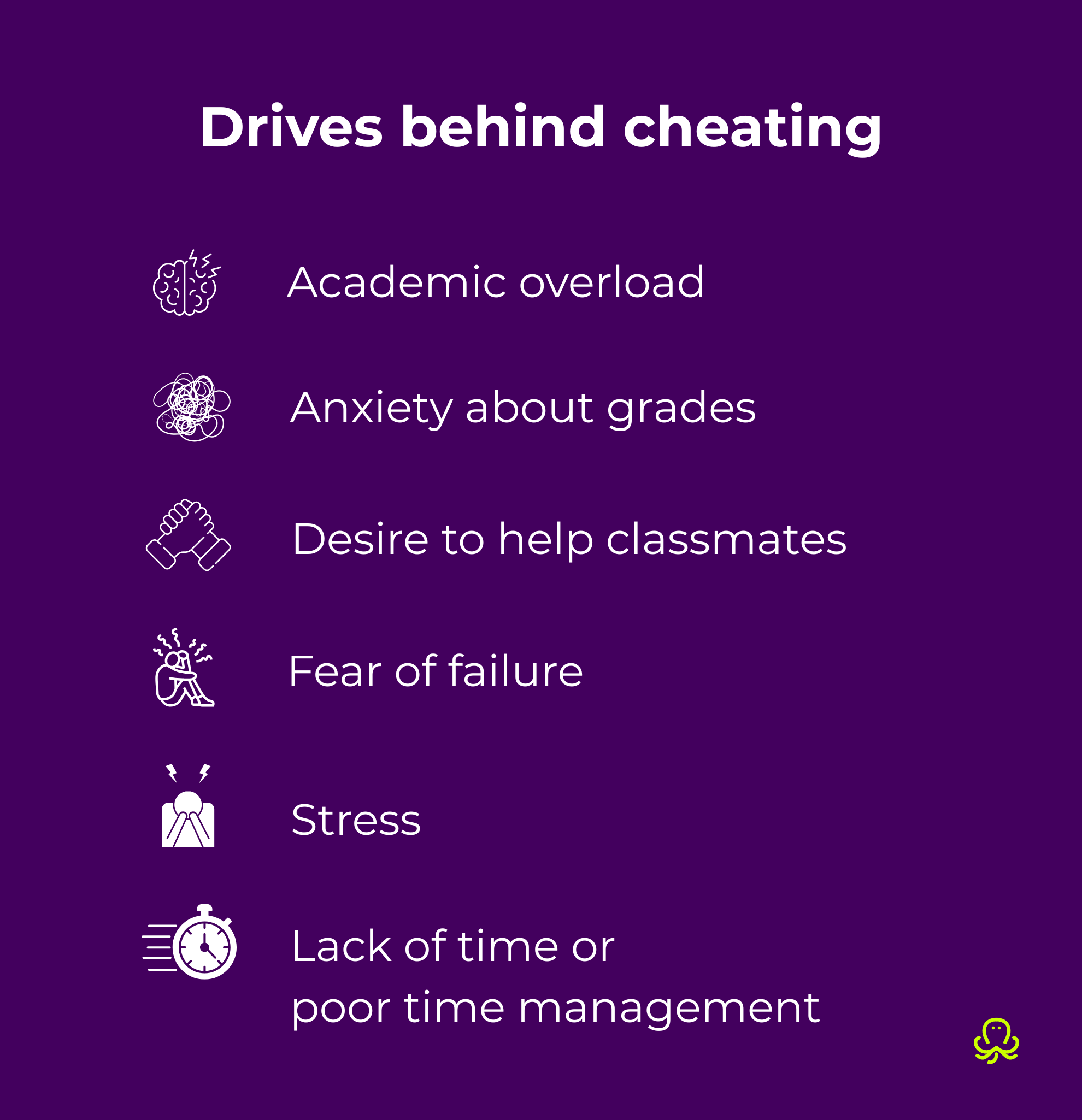
Moral panic misses the workload piles, vague instructions, low confidence, and societal conformance that make grades feel like consequential indicators of one's own worth. All these factors maintain suffocating pressure throughout life and thus, especially with time, dishonest shortcuts become easier to justify to oneself without much remorse.
Students under pressure do not always ask what is right; they ask what gets them through the week with the least damage. Instead of a theatrical rebellion of delinquent generations, modern cheating is a mechanical, self-preservation resolve.
You cheat, I cheat, we all cheat. Regardless of the emotions behind cheating narratives, we all know that cheating is far from exceptional.
I often had quarrels with my mom concerning math. You see, there was only one model student in my class. And my argument for another failed geometry exam was “but mom, everyone got Fs!” In a classical post-Soviet manner, she would answer: “if everyone jumped out of the window, would you do so too?” Yup, mom evidently did not know about Asch’s conformity studies, just like pedagogues who caused my year-long moral and academic disengagement. If skeptical, look at recent studies.
Ntumi and Bulala found higher academic dishonesty in Ghanaian senior high students compared to Botswanian peers. The 2026 paper links this to socio-cultural differences in understanding and tolerating misconduct, and variations in integrity enforcement. Likewise, a 2026 study by Palifka, Hanson-DeFusco, and Shi of 535 Mexican and US university students shows that those perceiving more corruption are more likely to cheat. Peer behaviors and tolerance in a more corrupt Mexican setting increase cheating tendencies, with attitudes linked to personal copying experiences indicating self-justification.
In 1993, Cohen, Pant, and Sharp found that individuals in low-uncertainty-avoidance cultures use broader ethical frameworks. Marhoon and Wardman’s Bahraini participants in 2018 justified cheating with friends due to collectivist beliefs emphasizing commitment and responsibility, which reduce autonomy. Conversely, New Zealanders viewed cheating as unethical, linked to lack of knowledge, and believed the risk of being caught discourages it. They saw learning as personal responsibility and cheating as unhelpful for growth.
What if I said that academic integrity is frequently insufficiently communicated institution-wide?
Higher education often talks about academic dishonesty the way workplaces talk about fire exits: the rules are technically there, usually in the syllabus nobody reads. As a student, I have never heard a lecturer actually discuss cheating and why we should care about it. It is rather implied that we are adults and know it ourselves. Also, in their majority, students care about honor codes as much as the internet cares about terms of use – sigh, scroll down, sign, done.

In a 2025 study, Long notes that faculty underreport academic misconduct for a variety of reasons, including insufficient time, the triviality of the offense, insufficient evidence, and institutional variation in reporting expectations.
The 2025 HEPI student survey found students describing university AI policy as “very mixed messages,” while The Chronicle’s Sarah Huddleston reported that most colleges still do not have campuswide AI classroom policies, leaving overwhelmed instructors to build their own syllabi.
Some students cheat because education itself increasingly tutors transactional thinking. When grades, throughput, employability, and performance metrics dominate the student experience, learning can start to feel secondary to output.
Thus, a 2026 paper by Mesny, Roberge-Maltais, and Galy criticizes current higher-ed assessment and grading practices for their limited capacity to promote deep learning. Modern assessment is, in fact, nascent. It misaligns with pressing challenges such as academic integrity in the age of generative AI.
Returning to Marhoon and Wardman, the contrast is telling. New Zealand students framed mistakes as part of mastery and said they would not let others copy, but would help them understand. At the same time, they still struggled to define when collaboration crossed the line into cheating. Bahraini participants, meanwhile, were more focused on avoiding negative judgment through high performance. That kind of performance orientation can make academic dishonesty easier to rationalize, especially where education is experienced less as a site of insight and more as a route to social or financial success.
If students get one message from policy, another from faculty practice, and a third from society about what success is supposed to look like, of course they will restitch the rules to fit their needs. Assessment expectations need to be transparent and socially legible beyond the classroom.
Generative AI did not invent cheating in schools. What it did was make shortcut-taking faster, cheaper, more private, and easier to rationalize as assistance rather than misconduct. There is no risk of getting one’s friends caught when copying from them. There are no feelings and no blame when you can dehumanize whatever an AI is while presenting generated words as your own.
The classic term for AI assistance in student writing with minimal cognitive engagement would be cognitive offloading or parroting.
In a 2025 study, Yusof et. al found that AI parroting was driven most strongly by extraneous pressures, followed by writing-confidence and conceptual-understanding challenges. Ethical rationalization, meanwhile, became more pronounced when institutional guidance on AI use was unclear.
In their 2025 systematic review, Balalle and Pannilage argue that AI has a Janus-like role in higher education, supporting academic work while also undermining academic integrity. When a student can get an outline, summary, rewrite, explanation, and polished paragraph in seconds, the barrier to cheating changes, and researchers like Birks and Clare, and Hammond et al. answered by calling for the redefinition of AI plagiarism.
To me, Hagège mentioning there is no proper definition of academic integrity in 2023 is ironic. And I agree with it. That’s why I bothered to explore cheating beyond McCabe’s 95% of students confessing to cheating 2015 statistics.
As educators, we should not wait for compliance nudge, but be at the forefront of shaping policies and perceptions of AI.
I was particularly fascinated by the essay by Ellen O'Connell Whittet where the author chose to actually explain AI use tells and why those are actually bad. Not because someone used AI, but because of flatness and predictability in those responses. Students were naturally discouraged from that type of cheating because now they saw what their professor did. Whittet increased students’ AI literacy, and it cost less than an academic integrity investigation because it fostered a culture that students will take with them beyond that class.
An integrity culture cannot survive on a few caring educators and fewer unicorn students. Education cannot remain in constant conflict with cultural reality, because that friction will almost always lead to some form of cheating. That is what social learning and normative influence do, after all: your milieu defines what is normal and ultimately who you become within the system. So, I am incredibly mad that Whittet’s experiment is not the norm in modern education, because its brilliance is in its simplicity and dialogue.
In the debates surrounding AI, many of us at OctoProctor actually support its careful use under relevant guardrails and policies, where applicable. AI convenience industrialized the desire to cut corners, and the only way out is to accept the new reality and redesign how we learn and assess.
Maybe your way out can be a proctored open-book exam, maybe you would like to offer hybrid proctored adaptive tests. I don’t know what fits your class, ask them.
As a final piece of advice, before turning all proctoring metrics to the max, sit your own exam. A very sobering and humbling experience. I bet the last time you had an exam was at least a decade ago.
Proctored exams built around transparency and your cohort’s context can help you prevent proxy test taking and exam leaks, besides discouraging the use of other cheating methods, including AI.
Talk to usAcademic dishonesty is any attempt to gain academic credit through dishonest means, whether that means plagiarism, unauthorized collaboration, fabrication, impersonation, or using tools and materials that were not allowed for the task.
Examples of academic cheating include copying during an exam, using hidden notes, getting live help through messages or Discord, proxy test-taking, unauthorized AI use, plagiarism, contract cheating, and fabricating references or data.
People cheat in exams because the stakes feel high, the opportunity exists, the boundaries are sometimes blurry, and many students convince themselves the shortcut is temporary, necessary, or harmless.
There is no single relevant global number for how many students cheat in college, because definitions, methods, and institutional reporting vary. Blogs and articles often reference McCabe’s 75-95%, but the said research is more than a decade old, and it is incredibly tricky finding the original source. That is why this article focuses on recent, sourced academic dishonesty statistics rather than a recycled headline percentage.
Academic cheating is one form of academic misconduct. It usually refers to using unauthorized help, devices, information, or another person’s work to improve performance on an exam, quiz, assignment, or coursework task.
Global cheating culture refers to the broader social normalization of dishonest shortcuts across educational and national contexts, especially when peer behavior, weak enforcement, tolerance of corruption, or contradictory success norms shape what feels acceptable.
AI use is now mainstream, but it is falling out of popularity, especially within humanities majors; plagiarism is no longer the only integrity concern and has actually decreased from 19 per 1,000 students to 15.2 per 1,000 as reported by the Guardian, detector accuracy discriminates EFL, and institutions are still redesigning assessment around the new reality.
In practice, academic dishonesty means presenting performance, knowledge, or evidence as your own when the work was produced dishonestly, with unauthorized help, or under conditions that violated the rules.
That varies a lot by institution and broader culture. In many settings, students may condemn cheating in principle but still avoid reporting it because of loyalty, fear, or normalization. There is no universal figure, but the answer is usually: fewer than institutions would hope. A 2022 study by Waltzer, Samuelson and Dahl of undergraduates at a U.S. public university found that only 11% said they would report cheating in the general case, while 40% said it depended on the circumstances. Reporting rose sharply when the misconduct directly affected them: 79% said they would report plagiarism of their own work.


Is everyone cheating in college because of AI? Or is AI simply exposing deeper problems in how we design exams and measure learning? A reflection on AI in higher education, cheating with AI, and why nostalgia may not fix the system.