Remote exams now play a central role in higher education and professional certification because they expand access. Candidates can take assessments from almost anywhere, which removes geographic barriers and accommodates different physical or personal circumstances.
Accessibility alone, however, does not guarantee fairness or security. Institutions and certification bodies must still ensure consistent supervision across every session and protect the credibility of exam outcomes.
Yet many institutions and organizations rely on live invigilation as a primary safeguard, even as hidden pressures emerge once exam volume increases. Staffing costs escalate quickly, human attention is finite, documentation remains manual, and disruptions such as live proctor no-shows, exam spikes, or time zone differences place additional strain on assessment teams.
Automation changes this dynamic. Thoughtfully applied AI-assisted workflows support human judgment rather than replace it. These systems handle volume, record evidence, and absorb operational shocks.
Live invigilation has long served as the default solution for exam integrity. A human supervisor’s presence appears to provide reassurance and control, particularly for high-stakes assessments.
But in practice, this approach comes with challenges that planning does not always reveal. Institutions may follow best practices for when and how to use live proctoring, only to find that real-world conditions bring operational, human, and ethical complexity that policies alone cannot absorb.
The following sections examine where these pressures surface first and why they matter for both exam reliability and day-to-day assessment operations.
Live supervision becomes expensive when organizations assign proctors to every exam, regardless of the stakes. Direct compensation represents only the most visible portion of the cost.
The larger expense comes from operating live proctoring as a system. Supervisors schedule staff, monitor sessions in real time, and resolve issues as they occur. During busy exam periods, teams extend shifts, accumulate overtime, and carry sustained cognitive load, all while maintaining constant attention and consistency.
As exam volume grows, these demands compound quickly.
Institutions also incur significant costs when they hire and retain qualified invigilators. Recruiting candidates, conducting background checks, and delivering initial training require time and resources. Ongoing refresher training and supervisory support further raise proctoring operational costs, especially in environments with high turnover.
Our guide on how to select live proctors outlines practical steps institutions can take to build reliable teams and avoid common hiring mistakes.
When institutions overlook onboarding and training, problems surface later down the line. Poorly prepared supervisors make more judgment errors and miss incidents, which increases reviews, appeals, and rework. High turnover then reinforces this cycle and places additional strain on staffing and administrative resources.
Institutions that oversee high-stakes online exams often need a more deliberate approach to live supervision. Our live proctoring solution equips proctors with clear, real-time monitoring tools while giving institutions visibility into proctor activity during exams. This transparency helps teams maintain consistent oversight and identify issues early, without relying on additional supervisory layers.
Live invigilators bring expertise to exam sessions, but they also have inherent limits. Sustained attention over long periods leads to proctor fatigue and situational awareness gaps. After several back-to-back sessions, even experienced proctors may face cognitive and physical strain.
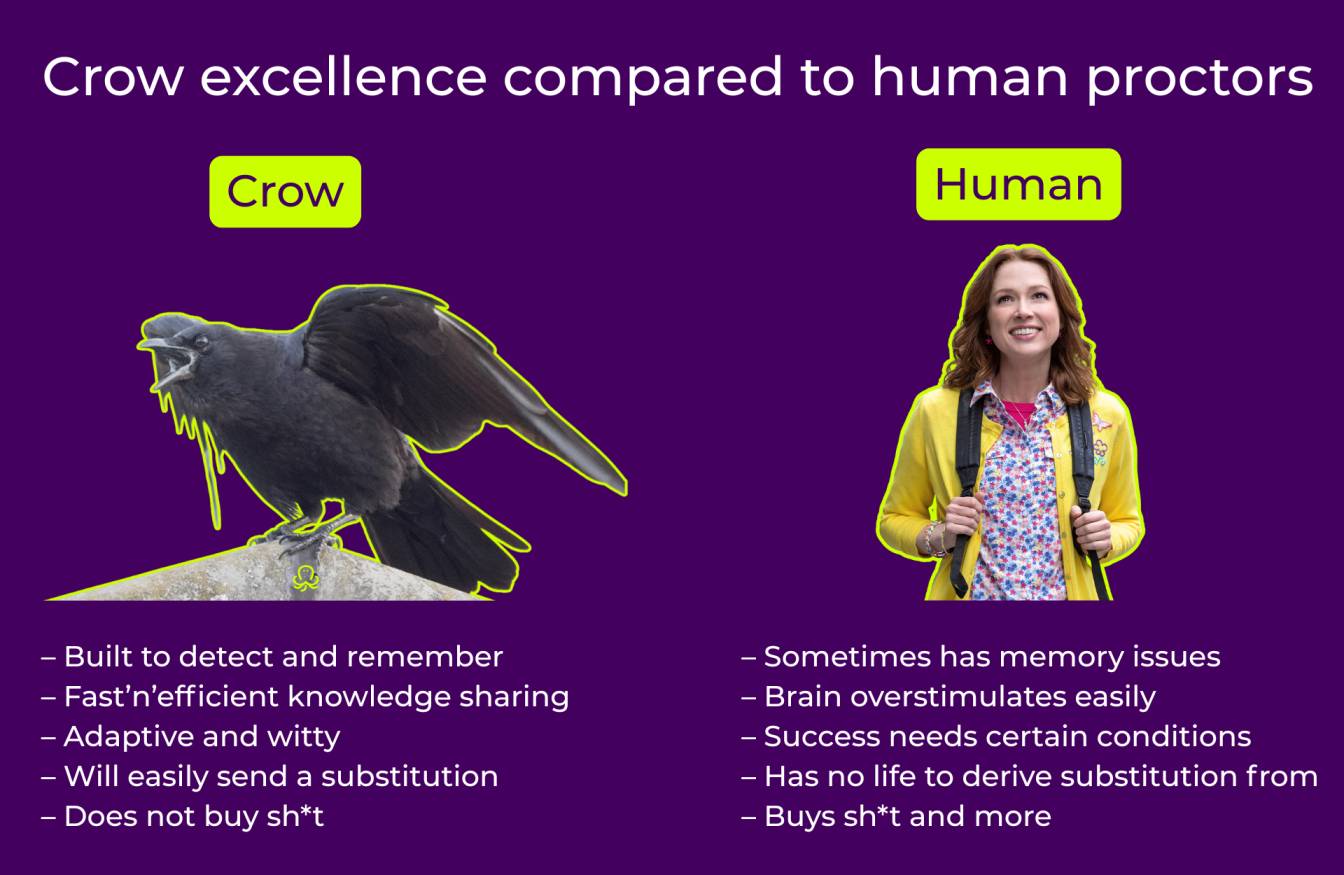
Research by Hügli et al. shows that when a proctor monitors multiple participants simultaneously, attention can become biased under heavy cognitive load. This increases the risk of missed signals and human error in exam proctoring. Their findings also indicate that small errors or misaligned cues can significantly decrease overall detection performance.
Assigning too many test takers to a single proctor amplifies these human-only exam supervision challenges and undermines consistency across sessions. In practice, a live proctor can actively respond to only one issue at a time while other alerts continue to accumulate. During large-scale assessments, this creates delays and exacerbates mass monitoring limitations.
Evidence from Chen et al. demonstrates that collaboration between humans and AI can reduce workload while maintaining decision quality. Research shows that AI assistance shortens review time by more than 25 percent without compromising accuracy. For proctoring teams, this translates into fewer extended shifts and more sustainable supervision.
Building on these insights, we offer flexible, science-based automation that complements human oversight rather than replacing it. For organizations seeking to limit dependence on live proctors entirely, our auto-proctoring solution offers an alternative approach designed to scale without increasing cognitive burden.
Source: Inayat et al.; Chen et al.
Live proctoring raises distinct ethical concerns because human supervisors carry personal biases, assumptions, and motivations into the exam environment. Even well-trained proctors can act inappropriately. In fact, documented cases show live invigilators engaging in unwelcome or improper communication with test takers, which undermines trust and raises serious questions about fairness.
Research by Inayat et al. shows that even trusted individuals with legitimate access can unintentionally or deliberately misuse information. These findings reinforce the need for systems that limit opportunities for misconduct by design. In a proctoring context, such risks highlight the importance of strong PII protection in proctoring and clear boundaries around human access to sensitive data.
Technology mitigates these risks while preserving fairness. At OctoProctor, automated identity verification removes live proctors from routine PII handling. This approach lowers the risk of inappropriate behavior without weakening exam oversight.
Working conditions also influence ethical outcomes. Gaps in oversight, unclear escalation paths, or inconsistent review processes can increase the risk of judgment lapses during sensitive exam situations. Our platform supports institutions through transparent, auditable monitoring while protecting candidate data across the exam lifecycle.
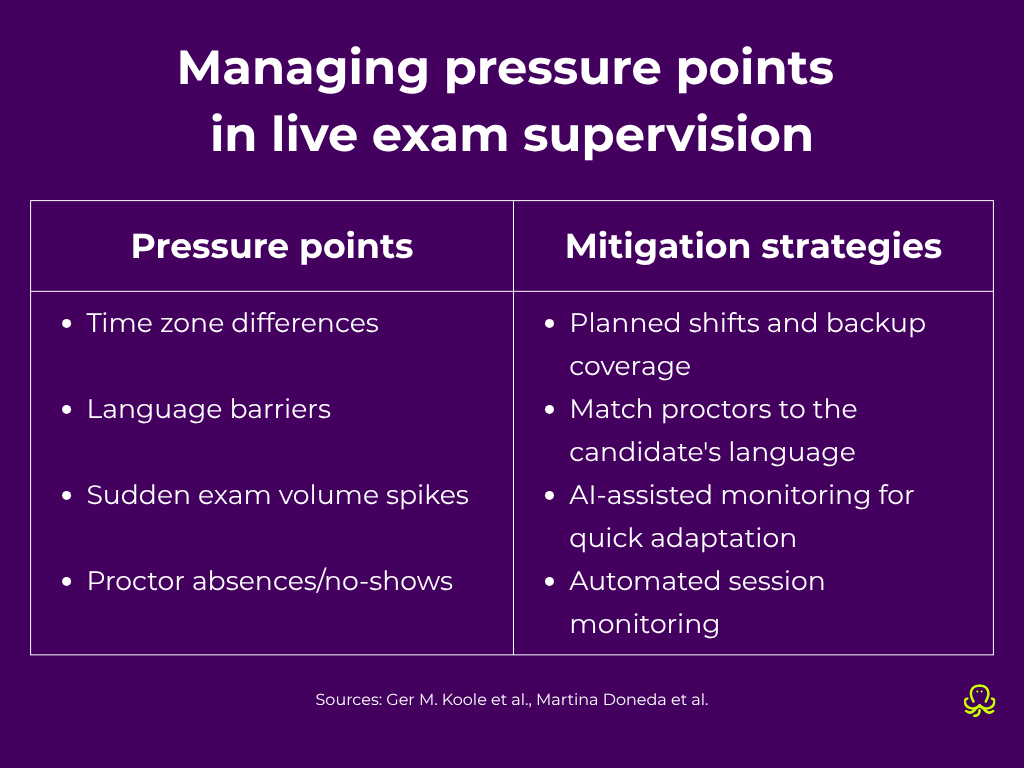
Exam invigilation problems can surface at any time and quickly affect the entire assessment process. Common pressure points include:
In reality, these problems often happen at the same time. For instance, an exam that runs late in one region can force teams elsewhere to extend coverage, while supervisors simultaneously manage candidates across multiple languages or formats.
Research on call center workforce management by Ger M. Koole et al. shows that organizations handle peak periods more effectively when they anticipate changes in staff availability and build in additional coverage. Related research on absenteeism by Martina Doneda et al. suggests that maintaining backup capacity helps organizations avoid operational disruption when staff are absent at short notice.
Although we do not automate scheduling, assessment teams using OctoProctor leverage AI alongside live proctoring to respond effectively when conditions shift. Our platform gives supervisors real-time visibility into exam sessions, which enables them to adjust coverage and priorities immediately.
Human judgment paired with machine support helps institutions maintain steady supervision during high-volume periods or sudden disruptions. For a deeper look at this approach, see our in-depth article on hybrid proctoring: combining AI with human review.
Live proctoring without automated support relies on manual documentation. Proctors take detailed notes, capture screenshots for every incident, and track timestamps for key events. They then attach each piece of evidence to the correct candidate record, often under time pressure.
Staff later explain this documentation to an integrity committee. This process adds hours of administrative work to payroll, as teams review screenshots, reconstruct timelines, and clarify what occurred during each session.
When evidence is incomplete or unclear, exam boards face difficult trade-offs. They may impose overly strict penalties, or they may compensate by ordering re-marking, offering free resits, or reopening cases. Both paths increase the likelihood of candidate appeals, and poorly structured records make those appeals harder and more time-consuming to review.
OctoProctor simplifies exam evidence collection through automation. The platform logs important events (such as session joins, pauses, warnings, and reconnects) with precise timestamps. Proctors no longer reconstruct events from memory, which saves time, improves consistency, and supports clearer reviews.
Learn more about how our AI proctoring solution supports faster monitoring and review processes.
Structured incident reporting further consolidates relevant information into a single, easy-to-review record. Standardized evidence capture and presentation streamline documentation and make exam misconduct investigations faster, clearer, and more reliable.
Many of the challenges tied to live invigilation only become clear once institutions operate exams across large assessment programs. Constraints on staffing, attention, and oversight can gradually erode consistency, while ethical risk increases when supervision depends on broad human access to sensitive candidate data.
Automation in exam proctoring reshapes how institutions address these pressures. In a hybrid model, technology handles volume, records events, and supports decision-making, which allows human proctors to focus on oversight rather than manual workload. Institutions and certification bodies can maintain fair, reliable, and resilient exam delivery, even under demanding conditions.
Address the challenges of live proctoring with OctoProctor's hybrid solution. Pair human expertise with AI or automated workflows to keep exams secure and manageable 🐙
Get in touch!When a live proctor is absent from a scheduled remote exam, the session may lose active supervision. Cheating or other irregular behavior can go unnoticed, which compromises the fairness and weakens confidence in exam outcomes. Hybrid proctoring and automated monitoring maintain baseline oversight and reduce the risk of missed incidents when staffing gaps occur.
Human proctors bring experience and judgment, but fatigue, cognitive load, and personal expectations influence how they notice or interpret incidents. These factors can produce inconsistent outcomes across sessions. When institutions use OctoProctor in a hybrid model, clear logs and structured reports standardize reviews and limit reliance on subjective interpretation.
Hybrid proctoring combines human oversight with AI or automated support to address the limitations of live-only supervision. Automation detects patterns, manages volume, and documents events, while humans focus on judgment in complex or sensitive cases. This approach strengthens reliability and resilience, particularly during high-volume or disrupted exam periods.