Some say university is not for everyone. It mostly comes up during discussions about bachelor’s dropout rates or student debt. Personally, I think having a bachelor’s degree still matters. But chasing education beyond that? Yeah. Definitely not for everyone, despite some cultures forcing it down undergrads’ throats. Some of the reasons for getting a master's degree include:
See? That brings a hell of a lot of reasons to test the pre-existing knowledge. For institutions dealing with global applicant pools, master’s entrance exams are one way to verify readiness before the classroom pays the price. Unless your institution is for-profit-only, you would want to keep your ratings and reputation competitive, as more prospects doubt whether they need a master’s degree and from where.
Master’s programs tend to be more international than bachelor's ones. Hence, standardization is needed to ensure everyone meets the basics, especially in high-paced STEM programs. You might think that STEM is more or less clear, and I should have directed my jab at the humanities. Fair enough, but we also rarely sit in labs.
.png)
For many STEM undergrads, a master's degree is an opportunity to level up. Wanting to get into top labs is an understandable motivation, they really open the door into high-paid, high-reward science.
The question will be how an undergraduate from an unranked small university compares to a lab team in POSTECH? Likely, there will be a huge divide in skills and knowledge. The entrance exam helps compare international students for competitive intakes by creating a common metric when GPAs, transcripts, and institutions are not comparable.
In my practice as an admission counselor, some educators tend to give lax grades when they know a graduate is upgrading to a top university that opens more possibilities. Or, candidates felt uneasy about unfairly low grades from prejudiced educators. In both cases, entrance exam-based admission gives equal opportunity to redeem oneself and verify credibility.
Any manipulation of student grades carries tangible economic consequences. A teacher with one standard deviation higher average grade inflation affects their pupils' lifetime earnings by $213,872 each year, according to Denning et al.
I still do not believe in the credibility of US standardized tests or in their ability to curb GPA inflation. Doesn't matter whether we're talking about online or test-center versions; fraud and inequality still find a way. I also think that broad standardization should remain in bachelor’s programs. Master’s admissions should be about nuance and the best fit for the advanced program (that is, hopefully as unique as its candidates).
In my admissions consulting, I work mostly with non-native speakers who pass both language- and subject-specific standardized tests. Some tutors prep for standardized exams in a way that builds only a knowledge facade. If schools require a 6.0 IELTS score, many students would bring exactly that. One would need more than barely there reading comprehension in a competitive lab.
Professors will discover the knowledge gap too late to act post-admission. Hence, I still insist on institution and program-specific evaluation that assesses beyond standardized memorization and test-taking skills.
.png)
Before, a master’s was legitimately an advanced degree. Now it has an industrialized, mass-market feel that removes “specialty” from knowledge.
I always ask my customers what expertise or skill they will deepen, especially if the degree concludes with a thesis. Often, the lack of specificity outweighs confidence in proficiency and how it will evolve by the conclusion of the program. Taking a Master’s for the sake of having it dilutes the credibility of the degree. Postgraduate degrees are not supposed to be another bachelor’s playground.
Diploma-for-the-sake-of-diploma programs exist, with lighter application requirements. The courses offered and faculty are very superficial, barely enough to tick off the master’s qualification. Nonetheless, CV demands drive the target audience of such programs to seek out top schools. The pressure to get in causes graduate admissions fraud. The means include inflated GPAs, untrustworthy recommendations, falsified CVs, exam cheating, and essay mules.
Exams, especially proctored exams, serve as applicant identity verification and authorship verification. They also keep the influx thoughtful and manageable. Applicants often apply to 10+ programs, and I have seen cases where a single applicant targeted over 50 universities in the United States. Of course, it happened with minimal fit.
The rapid increase in student numbers often outpaces resource growth, leading to overcrowded classrooms and diminished faculty-student ratios. Even with smaller classes of 15-20 students, the time deficit remains tangible for those engaged in advanced research. Massification often makes it difficult to maintain personalized instruction, reducing opportunities for feedback. In some contexts, massification has led to a lowering of academic standards or to difficulty maintaining them. In other words, the degree got devalued due to the sheer number of people who graduate with it each year.

The difference between admitting the best of the best and admitting the best of the worst is hard to ignore. That is the core of my broader argument for master’s admission exams. Institutions are also protecting their reputation: maintaining consistently strong rankings, building cohorts worth competing for, and proving program quality through graduate employability.
An institution may be tempted to choose an easier road by overcharging and hiring primarily the wealthy. It does not guarantee academic cohort quality, but it narrows intake. To avoid massification caused by rapid student growth and retain robust networks and a good reputation, institutions must foremost maintain academic standards at the entry stage.
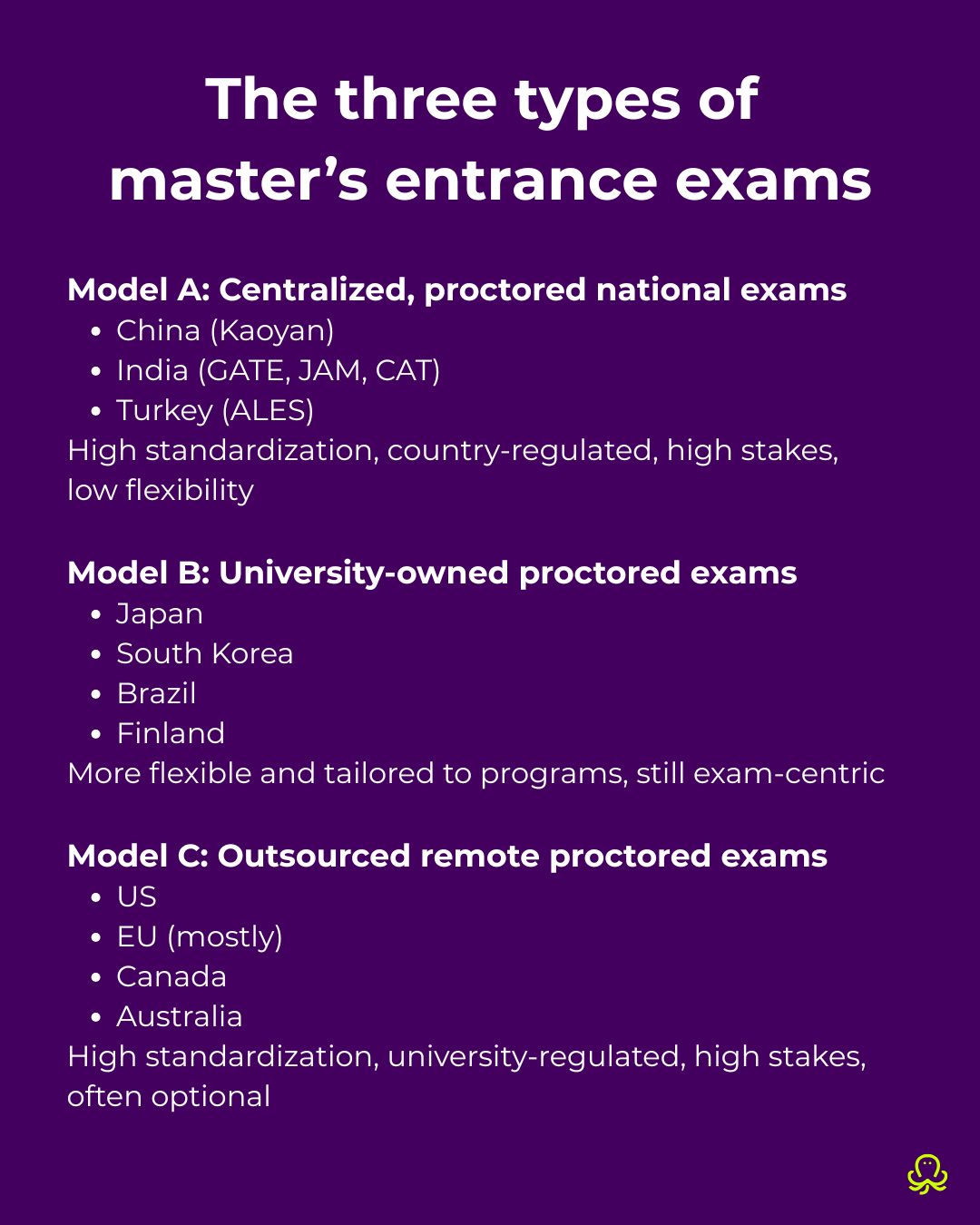
Globally, these systems range from national postgraduate entrance exams to university-owned tests and outsourced remote proctored admission exams.
In China, all master’s candidates must pass a national exam to satisfy merit-based selection standards. Kaoyan offers second-tier university graduates a chance while acting as a fair bottleneck.
Similar to China, Turkiye requires a mandatory ALES exam for anyone seeking admission to graduate or postgraduate programs or academic positions.
India also has highly competitive national entrance exams for those interested in advanced studies – JAM, GATE, and CAT. Unfortunately, GATE's credibility was undermined in 2026 by a nationwide cheating scandal, highlighting the need for advanced proctoring.
In Japan, most universities require entrance exams for master's programs. Thus, each university organizes its own assessment, which may include written tests, interviews, or research presentations. Likewise, South Korea's graduate admissions process includes departmental oral interviews, document screening, and university-specific aptitude tests to measure research capacity and academic background.
Brazil combines standardized subject-specific and university-run entry tests with research project proposals, oral defenses, and CV evaluations.
The US, Canada, Australia, and most European countries outsource their admissions exams, using the GRE, MCAT, LSAT, and GMAT to verify knowledge, although these exams are often optional.
Besides some individual exceptions scattered across Europe, there is a notable outsider, similar to the Brazilian hybrid model. In Finland, some universities use their own assessment instead of the UAS graduate entry tests.
The bigger question is whether you need an admission exam at all and what problem you are trying to solve. I have developed a set of questions to help you better understand your case.
If your program is research-heavy, exams alone will underperform. A better combination would be a proposal and/or an interview plus an exam. If your program is skills-heavy, exams alone become more defensible.
We get it – getting proctoring for only one program’s entrance tests may sound too fancy for many lean universities. The feature that makes Octo essential for entrance tests is our flexibility. Not all exams require the same level of control. Ideally, the product should be useful across programs beyond admission cycles.
OctoProctor provides AI, automated, and live proctoring in one platform. That way, your procurement decision can support both: a department needing an automated solution during finals and another department requiring real-time monitoring, identity-sensitive screening, or scenario-based assessment for competitive entry.
In case of low comparability, exams make sense as a baseline. You might think that admitting mostly nationally is an easy case, but the knowledge disparity is considerable. Nonetheless, high comparability can result in additional admission exams becoming redundant noise rather than a rigorous marker.
I also encourage you to look beyond intellectual comparability when deciding on an online graduate school entrance exam. Ask admission officers to gather information on candidate geography and their most widespread enrollment struggles. In particular, look for the digital divide.
Your school must consider whether the exam delivery method will perform reliably in real-world scenarios. It sucks when candidates are doing their best, and the progress is lost because something goes off. It is incredibly frustrating to download something over a low-bandwidth connection. It is nasty when one is left out because their device is not supported. That’s why OctoProctor offers a device-agnostic, fully browser-based infrastructure for online admission exams.
In high-competition environments, you will need a ranking mechanism that benefits from exams. Low competition/for-profit programs will only suffer from exams due to friction and drop-off.
Low admission rate or large programs mean that you are likely to have:
– a fair amount of dissatisfied, panicked, or perfectionist candidates texting your admissions with a lot of questions pre-exam
– another considerable amount, letting your support know their concerns and confusion during the exam itself
– a good portion knocking on admissions’ doors again to know why they failed and challenge the results.
Yikes, right? OctoProctor eliminates common proctoring frustrations. Our manuals are easy to understand, and your test takers can always try our little self-demo to see that proctoring isn't scary. The platform restores sessions after connection interruptions, letting the support team focus on what’s really a problem. Admissions teams may scale from 100 to 10,000 applicants with a few coordinated clicks. For example, OctoProctor powered a simultaneous Olympiad for 1,000 test-takers. Less than 5% required help, and all proctoring data was saved for later review.
Have you seen cases of:

A proctored component becomes a control layer if you answer yes enthusiastically to the first question. And, a no to my second question means you’re relying on trust in a market that increasingly exploits it. Which, in turn, undermines your credibility and that of your graduates.
Proctoring is not something that will directly save you from ghostwritten docs or inflated CVs. But if you experience these problems at scale, a strict proctored exam instead of four ghostwritten essays will help you determine if the info on the applicant’s academic background is realistic.
Post-test reporting, content protection, and suspicious-environment controls, including browser extension blocking and virtual machine detection, are what you should be looking for if you want to curb admission fraud.
Are you more afraid of:
Exams reduce the uncertainty of learning, and you recruited an “imposter,” but also filter out non-standard talent. This is a strategic and ideological choice. Technically, you can have a few routes and quotas, but it is also something you need to be transparent about with your candidates.
Can you:
If not, complete (GRE/GMAT-style) or partial outsourcing (HESI A2-style) may be safer because badly implemented exams are worse than none.
If you want to keep your exams in-house, there are still a few operational options you need to know about. Some schools prefer running candidate assessments in the LMS. Others opt for a quicker solution at scale, because creating and deleting temporary accounts for every applicant is bureaucratic. OctoProctor supports both by offering OctoPlay and integrations with 30+ LMS, including Moodle, Canvas, Open edX, Blackboard, D2L Brightspace, Sakai, and iSpring.
Credibility, privacy, and appeals frequently act as blockers when it comes to selecting a proctoring vendor for admission exams. We use minimal data and are cloud-based, which means we do not get system access like other vendors do after downloads. To top it off, our clients can select geo-specific data residency.
Once you’re clear on the above, the format decision becomes straightforward.
Trade-off: you gain scale and defensibility, but lose nuance and program fit. It will be manageable to game your exams due to their standardized nature.
Trade-off: you gain control and relevance, but take on operational and reputational risk if execution fails. Some students may also feel discouraged from applying because they will need to take an extra exam.
Trade-off: you preserve nuance, but increase exposure to inconsistency and fraud.
That one brilliant class of 2012 is, at best, sentimental marketing. A single arctic night of brilliance does not make up for years of average performance. The fact that institutions are holding on to that one triumph speaks much about the program's downfall.
I believe every class can be memorable, curated, and a high-return investment. The value of a strong master’s program lies in peer learning, alongside state-of-the-art facilities and top lecturers. A weak cohort would mean degraded learning for everyone.
The cohort engineering success starts at the entrance. Your integrity partner selection matters because it signals your values. Our product is not a generic monitoring layer. Instead, OctoProctor is designed as an infrastructure that supports admission decisions you may later need to justify, providing both configurable.
If you care about institutional prestige and what happens to your alums, you need to be stricter. High dropout rates or unfocused classes are evidence of weak recruitment rather than democratization. Moreover, admitting candidates who barely fit the acumen plank will not magically be solved at their graduation. Those who were not fit at the entrance will keep on struggling, including when searching for a job.
The latest is actually what should be sealing the deal. If your grads suffer in the job market, it’s evident they made the wrong choice. When admitting someone, you share credentials, and this person has the full capacity to ruin your reputation through association.
When speed, efficiency, and customization matter, the OctoProctor team seals it with proctoring expertise that’s beyond surveillance-only metrics. Our approach is foremost humane – we have all passed more than one exam :)
Talk to us!

What’s no longer working in US undergrad admissions and where performative, AI-tinged essays and generic test scores fall short? The “local era” demands its correctives, and owning entrance exams can be the case for your institution.