The problem of academic cheating is normal. Generational even.
Why is it growing and, most concerningly, why are the cum laude+ students beginning to engage with breaking ethical codes more? A few reasons. First, the population that gets some sort of college degree is bigger, so is the proportion of cheating students. Second, cheating detection has gotten more advanced. Third, students are forced to optimize more.

I have 10+ years of non-stop academic and work experience, currently wrapping up my PhD. The pain of being a student definitely knows my name. The following experiences are becoming universal, but might be just the tip of the iceberg:
– Entry jobs ask for 2-5 years of experience, meaning we have to work in the industry while studying (separate question about how to find those jobs).
– We have to make ends meet because the top higher education institutions are expensive, and 15 years of student debt will not be canceled by a fairy upon graduation.
– We are forced to find ways to get a high GPA, and it gets progressively harder because of grade inflation and favoritism.
– We want to have a life too – at least time for self-care because the crouched back and bad diet will knock on our doors when we get older as medical bills and insurance theatre.
– We are likely to need third-party validations, such as certificates and academic awards, to either continue education or get hired.
We have no choice but to optimize. Education has long been about anything but pure learning. In this race, FOMO is not social media-induced. I couldn’t care less about a Birkin that costs like half of a 2-bedroom apartment in Ivano-Frankivsk. We are worried that our children will be born into debt that we created to make ends meet.
This decade is one of the few opportunities to move up a few financial strata, but my generation is highly unlikely to become truly rich already. It is funny to me how governments are alarmed about low birth rates when they purposefully make our sole life goal owning a house.
The question should not be “how to create a completely sterile environment where nobody cheats.” The question should be “how we can make education and assessment realistic so the new generation begins to care beyond mechanics.”
Causes of cheating in exams are as diverse as students themselves. And the cheating techniques usually mirror the reason. I understand that it is hard knowing everyone’s circumstances when you have a large class. But I do recommend being more observant and including at least some surveys or questionnaires if you can’t physically interact with all your students beyond greeting.
Being a good educator works much better than aggressive panopticon triggered by every flag that may or may not mean a student is cheating. Yes, not everyone will open up, and reputation is definitely earned. But things will change for the better if you consistently pursue a culture of welcoming integrity instead of organizing a bonfire every time something triggers cheating in education. Understanding the root causes of academic cheating can help institutions develop more effective prevention strategies.
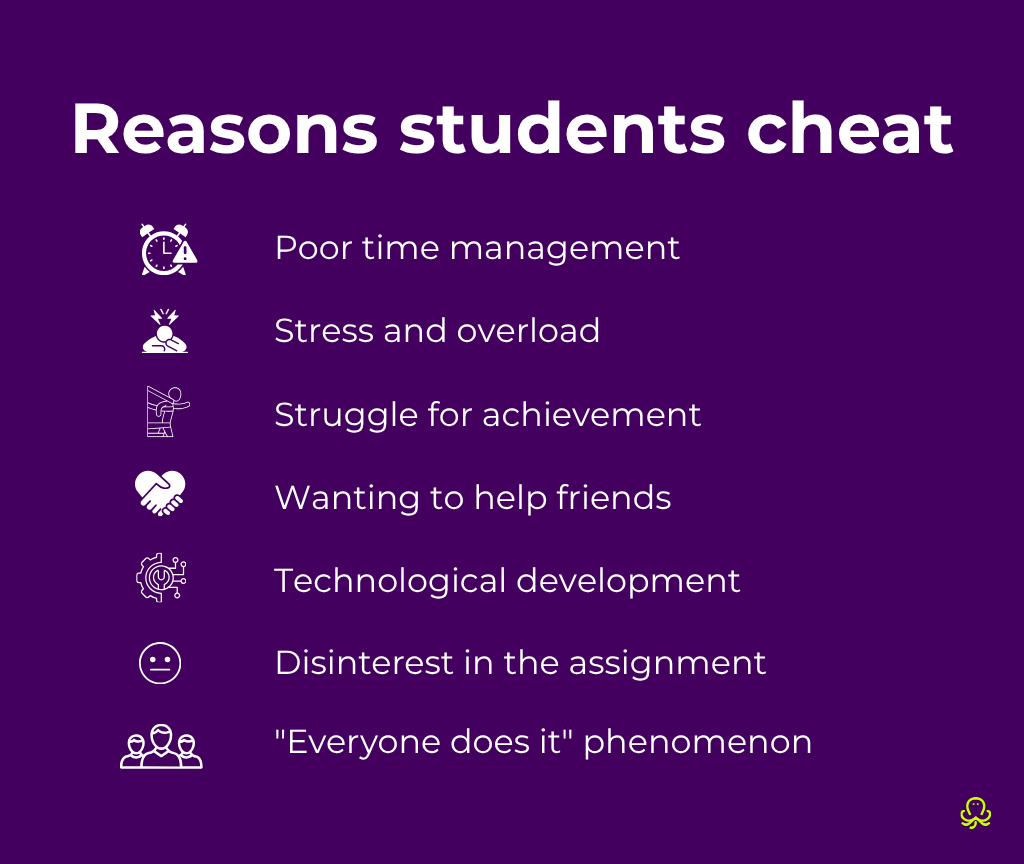
Poor time management is a common sighting in why do students cheat cause and effect lists.
It is painful to hear assumptions about another cheating student who drinks and clubs every day. Time-management-induced cheating during exam happens mostly because of juggling gigs and university workload.

Don’t even start telling me about how academic dishonesty is avoidable with good scheduling skills. Your lived experience is likely irrelevant to modern students if you graduated more than 10 years ago.
Students definitely do not appreciate someone who stopped being one of them decades ago and is now reminiscing about how superhuman they were back then. Imagine Elon Musk explaining budgeting and investing to someone on food stamps? Macabre class and accessibility mismatch.
What you can do is write a mindful, cohesive curriculum that is smooth in terms of skill and theory. If you taught students MCQs the entire semester and then asked them to sit down for 3 closed-book essays in 3 hours – students will cheat because their brains were not wired to think in that dimension. And, they will suffer while prepping.
Also, when discussing course deliverables, share wisdom you gathered from previous cohorts, especially about how to prioritize workload, break tasks into manageable steps, and set clear goals. I would have loved to hear how you caught cheating last year instead of the good grades importance.
Students also tend to feel less afraid when you show them previous year coursework examples. Tell about useful tools your students can use. A random online influencer changed my life by making a 1-minute reel about Connected Papers. Teach them how and when to use AI so their practice improves. Encourage regular study sessions.
Stress does not automatically make a student cheat, but it can make dishonest shortcuts feel unusually rational in the moment. I would go as far as to call it a form of cheating oneself out of one's own education.
When a test taker is overloaded, under-slept, overstimulated, or frightened by the stakes of an exam, their brain may simply roll out a blue screen. In a proctored setting, this kind of cognitive friction can also look suspicious: long pauses, nervous fidgeting, vocal stimming, or inconsistent eye movement are not always signs of misconduct.
Institutions can reduce cheating by making exam expectations clear, offering practice runs that mirror the real proctored environment, allowing back navigation when appropriate, using quiet and contextual notifications, and avoiding pre-high-stakes assessment fear-mongering. I explore cheating in exam problems and solutions more in memory lapses during high-stakes proctored exams.
A common factor contributing to student misconduct is the pressure to succeed. The emphasis in today's classrooms is on getting students to do well rather than on how they learn. Moreover, modern grading creates peer pressure among college students rather than peer learning.
Many students, particularly those with poor time-management skills, seek less rigorous means of achieving high GPAs because they know this will be the primary metric by which they will be judged. We are led to believe, by societal norms, that every successful person possesses exceptional intelligence and excels academically. Many students cheat because they are anxious about failing to meet these standards.
Students do not always help each other because they wake up and choose academic villainy instead of breakfast. In LATAM, Eastern European, and Middle Eastern cultures, helping a community member is a normal expression of loyalty and care. In fact, if you refuse to help, you will be ostracized – at least that's what happened when I told my classmate to get lost when he kept physically interacting with my history essay during the final exam.
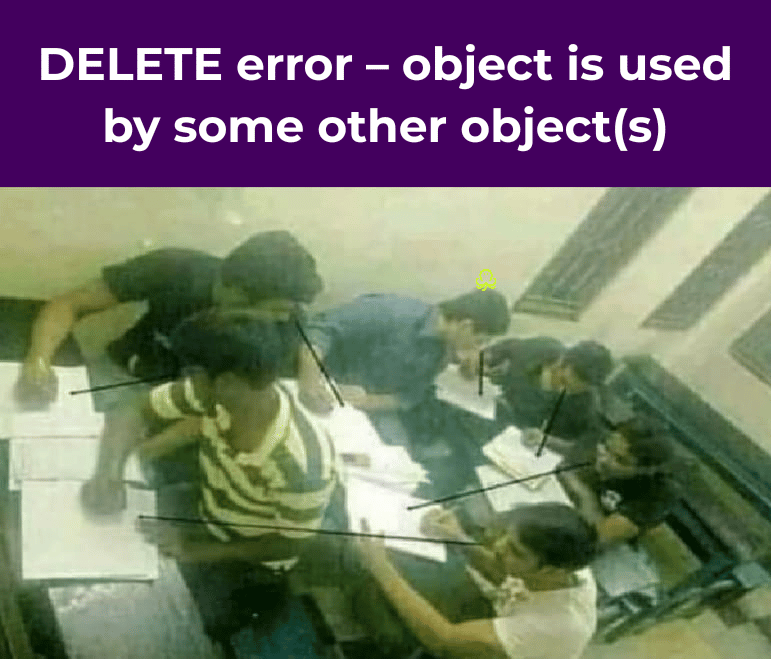
So, when collectivist and individualist cultures collide in an international institution, a syllabus hiding the actual boundary somewhere between page 10 and “you should have known” is a disaster. Frequently, learners also bring different understandings of integrity policies, in addition to cultural richness. No wonder students start freestyling the rules.
Explaining a concept and practicing together can support learning. Writing someone’s answer, feeding them exam responses, sharing screenshots of test questions, or “just checking” their work until it becomes yours with extra steps is where care becomes collusion.
Now transfer the distinction to online proctored exams, where helping a friend equals cheating behavior. A helper can sit off-camera, join a call, watch a shared screen, read screenshots, or send answers via a second device. I explored more cheating tactics and how to confirm what’s relevant to your case in how students try to cheat on proctored exams article.
If students understand which form of support constitutes cheating and that they compromise themselves primarily (yes, shift the accent from exam to students themselves), fewer people have to learn academic integrity through a disciplinary email, which is objectively a terrible teaching format.
Hear me out, I am not going to blame progress in high snobby language. I love progress.
I also do not think a digitized Johny Depp will mess up everything connected to the internet. So, I believe citing sources by hand is a dead art, and I am happy to have MyBib and Mendeley sort everything out for me.
And, because we are so interconnected and constantly participate in collaborative internet culture where Gauntlett’s “making is connecting” creates infinite informational nodes – the attribution barriers are quite nominal. People have become accustomed to using ideas or information found on the web as their own, because whatever is incorporated into their knowledge structures may already lack source attribution.
You should not blame the internet for all mankind’s sins just because it allegedly facilitates some types of cheating, such as browser-based AI agents. People cheated before the internet, and will cheat after it (whatever it means).
Instead of fighting progress and optimization, be a step ahead of it. Pentest, experiment, and encourage technology where possible.
Because students don't see the task as relevant to their studies, they optimize for things that matter. Even our CTO mentioned it in his origin story:
“I believe there's a fundamental motivation problem in the education system. I was genuinely interested in certain aspects of programming and dedicated a significant amount of time to them. As a result, I didn’t always have enough time for the rest of my studies – an experience I share with many. And it wasn’t very clear how some subjects would be useful in my life." – Anton Skshidlevsky, OctoProctor founder and CTO
Research is fairly annoying here because it supports the obvious: students are less likely to treat a task with care when it feels like a circus hoop. A meta-analysis by Anderman and Won (2021), reviewing 79 studies, found that academic dishonesty was negatively associated with intrinsic motivation, mastery goals, self-efficacy, utility value, and internal locus of control, while it was positively linked with amotivation and extrinsic goal orientation. Another study by Li, Wang, and Liu (2023), based on a sample of 455 students, found that high internal motivation and strong prosocial values reduced the tendency to cheat, while high external motivation was associated with higher academic misconduct.
Cheating spreads faster when students believe the honest ones are the unpaid interns of academic integrity. If classmates seem to get better grades with less effort, and nobody appears to notice, the question shifts from “Is this right?” to “Am I the only idiot still doing this properly?” That does not make cheating acceptable, but it does explain why peer behavior matters. Academic integrity is not only a personal value; it is also a social climate.
Scare campaigns rarely work when students already think the system is unfair and easy to game. A better approach is to make expectations visible, consequences consistent, and honest work feel like the normal route rather than a heroic sacrifice.
This is an expensive question. Institutions need to change their business-to-business operations and put students first.
Education stopped being the pure pursuit of knowledge many like to paint it. It is a corporation, incredibly classist, that will own whatever you produce unless you go indie at some point. To be a publishable researcher, you need a PhD and, better, an affiliation. That’s 10 years of your life here. What is crazier to me is that after commodifying a Master’s degree, education and business now do the same with PhDs.
The worst you can do to people desperately forcing themselves to get formal education just to make the bare minimum is hard compliance. They know institutions do not care about them. And it is ok; very little business will truly care about their employees either. Students will nonetheless appreciate the departure from jail-like enforcement and hierarchy. They would feel safer if they were included in their own education.
Now, I am not a fan of letting a screaming 5-year-old run through an airplane for 30 minutes during a 1-hour domestic flight. You are absolutely right to enforce some limits and not let a 2nd-year Bachelor student write a PhD thesis because they feel a little manic and see themselves as more clever than peers.
But do not brush them away or ignore either. Reverse the narrative from yourself and firm to them. How will engaging in writing a PhD thesis benefit the student now? Do they have the needed technical skills? How can they acquire the necessary skills to choose a Bachelor → PhD path in two years?
Academic honesty is rhetorical before it becomes technical. Students decode the person and institution delivering it.
Ethos asks whether you have the credibility to set the boundary. Logos explains why the academic misconduct boundary exists beyond “because the policy PDF said so.” Pathos decides whether the message lands like care, control, or erratic pathology. So, when cheating in education is communicated as “we will catch you,” the logos may be technically correct, but the ethos says prison guard and the pathos says panic.
If you want students to care about academic cheating, reverse the appeal: show what dishonest student behavior does to their learning, their classmates, and the value of the credential they are paying for with money, time, and sleep. Then make the rules readable enough that no one has to perform syllabus archaeology.
The possible abolition of lettered grades, which are a major contributor to external and internal pressure on students, helps with the rebranding of rhetoric. No more GPA Hunger Games. Speak thoughtfully. Praising a student for exceptional results is different from praising their efforts. The former emphasizes performance and may encourage cheating to satisfy teachers' (or society’s) high standards.

Back to exam cheating. Before, the ethics code was a source of fear and discomfort because it prosecuted students only. Reframe the appeal to how they hurt themselves. Tell, show, make it transparent. A mentally stable person wouldn’t want to hurt themselves, and you would want to keep your class as stable as possible if you want them to care about integrity.
Erase the distance between yourself and students in your comms as much as possible. A simple Foucauldian principle: “where there is power, there is resistance.” Stop conditioning yourself as a vertical source of power through compliance. Allow student agency and include them in curriculum and assessment development. They will have to know something to participate and propose meaningful course materials and assessment. That means they will be more engaged. Moreover, being able to work side by side with you changes students’ perception of course development and outcomes.
Of course, moving towards a holistic model is easier in face-to-face because students have to physically engage. You can still program course-building activities into the online curriculum. Forums are a good way to foster conversation and peer collaboration in online class.
In hybrid and online courses, you need proctoring more than in conventional delivery. Proctoring legitimizes your remote program regardless of whether you are a progressivist or conservative. The question lies in both how you present it and how you use it.
Proctoring is not anti-student. It benefits us to take the program from wherever we are, asynchronously even. It proves the legitimacy that is so disputed right now. Proctoring saves students time and money, so using it during exams is a better approach than free-market anarchy.
Proctoring is also more flexible than you think. Some products are highly customizeable and let you tailor the experience to the cohort and exam. I have seen significant concern about attendance and interaction with course materials uploaded to LMS. In that case, you can employ lightweight monitoring like OctoLite. The core difference from conventional proctoring is that OctoLite verifies participation, not exam behavior. It confirms identity, attendance, and continuous presence with audit-ready evidence, without adding full exam surveillance or lockdown.
So, stop cheating students out of opportunities. Do not enforce asterisks or other type of education devaluation that will make it harder for your students to get hired in an already cutthroat job market. Many choose online asynchronous degrees for reasons far from cheating.
No matter how hard this article blurs lines, you will always be a leader for the new generation. As someone who has experienced 2 revolutions and 1 war, including studying the social media narratives that legitimize them, I have two choices to offer you: either resist the change and be on the wrong side of it, or lead it. Leading it results in less destruction and pain.
You are where you are likely because of students who pushed for change and later became academics. A good student is not the one who sits straight at their desk. It is the one who defies the system and old worldviews.
Giordano Bruno was blamed for heresy and received a capital sentence because he defied Aristotelian geocentric beliefs. Bruno argued that the universe is infinite and that other solar systems exist – something now common knowledge. There would have been no today if not for scientists who challenged the world, even at the cost of their lives.
Breaking the ethical rules of one’s educational institution is an umbrella term test takers get slapped with first thing when something’s off. Using Grammarly and fabricating survey results are dramatically different. Blindly making the honor code stricter will not help because it will only prove how obsolete and disconnected the current integrity system is. It already has an ancient religious scroll vibe that most have not seen because it is irrelevant.
Student’s language is care. If you are going to be strict about academic integrity, show that you are doing so because you care about them. Explain why it hurts them realistically.
Second, academic cheating is an offense, but there should be a chance to redeem oneself. Reformation and reflection work better than expulsion. Conditional forgiveness will always be stronger than terminal anger. Developing a robust anti-cheating strategy and imposing new rules and restrictions destroys creativity and curiosity.
Before we part, I want to share a little anecdote.
When my 22-year-old mom gave birth to me, she was gifted a ton of pedagogy literature with conflicting viewpoints. Her circle tried to institutionalize her motherhood and my upbringing. Her response was “I will grow up together with my kid.” You too have the chance to grow up together with your students.
OctoProctor is a highly configurable solution that you can tailor with your students to meet both their needs and compliance requirements.
Talk to us!First, high-stakes assessments. When an exam determines whether one will proceed to the next academic level, receive a scholarship, etc., – the logic is to be safe than sorry. Second, boring and irrelevant subjects. Being more career-focused, students are likely to cheat with little to no remorse if the subject has no value in their future life.
There are many reasons why students cheat in exams: disinterest in the subject, lack of free time, need to provide for oneself, etc. Preventable if the faculty is more responsive, flexible, and pays more attention to student voices.
Analyze the teaching program and learning load. What’s more, think of ways to encourage a collaborative community and build the relationship between students and administrators. Last but not least, develop a strong academic culture, thereby laying the foundation for academic integrity and a strong reputation for your educational institution. Students learn faster not to cheat in respectable institutions than plagiarism detectors prevent cheating.
Cheating in exams causes and effects are the same as in bachelor's degree. A high school senior and a university freshman are not that different if the learner is not a senior. Both are yet to earn proper research skills and are not very familiar with common ethical frameworks.
A kid who is 17 years and 364 days is no different from a kid who is 18 years. The only thing that magically changes over the birthday night is their rights. Other than that, if you are teaching 101 AP or college courses, expect more accidental cheating.
Why do students cheat on tests should be ideally treated individually. Best practice is to always give the benefit of the doubt and investigate thoroughly before any accusations are made. For example, using a spell checker may have been caused by a person being an ESL student who is concerned about typos.